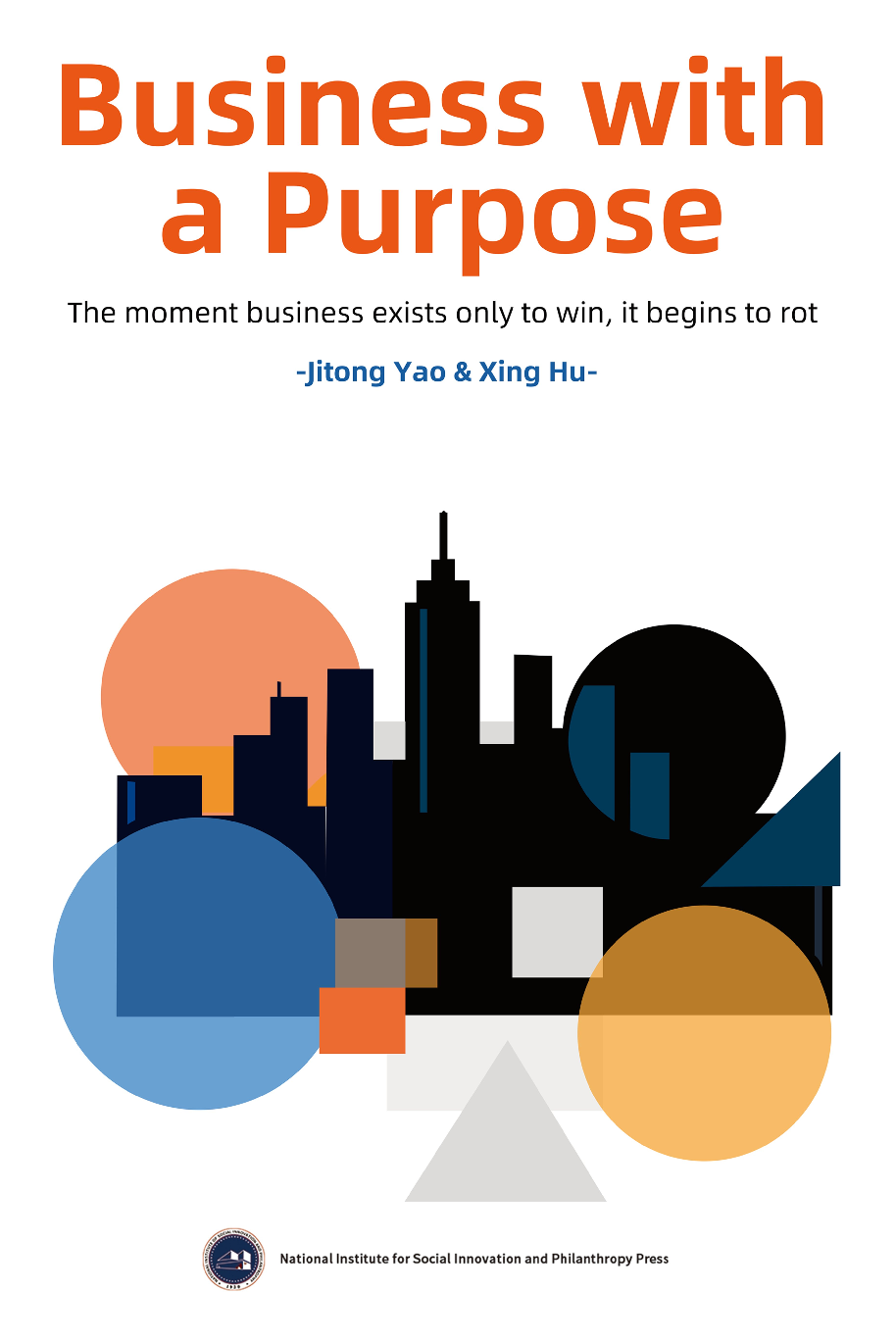
Business with a Purpose
The Moment Business Exists Only to Win, It Begins to Rot. A business and social innovation book about redesigning the relationship between profit, responsibility, and long-term social value.
Book Overview
Purpose as an operating system
Business with a Purpose argues that doing good cannot remain charity, branding, or a public-relations accessory. Purpose must become part of how modern organizations make decisions, generate revenue, govern themselves, collaborate, and survive economic cycles.
The book begins from a practical contradiction: companies often have scale without purpose at the center, while nonprofit and public-interest organizations often have purpose without durable mechanisms for scale. The book treats both as design problems.
Core Thesis
The future belongs to useful institutions
The future belongs not to companies that merely maximize profit, but to organizations that can embed usefulness, trust, and public value into their business model. Doing good should become part of strategy, incentives, governance, measurement, and long-term survival.
Companies must choose real social problems and align products, operations, partnerships, governance, and resource allocation around long-term responsibility.
Mission-driven organizations need sustainable revenue mechanisms so public-interest work can self-fund, self-grow, and self-replicate without losing integrity.
Purpose should be institutionalized through governance structures, decision rules, accountability, and measurable social or environmental goals.
The book proposes verified contribution units and portable records of good deeds to make public value visible, credible, comparable, and circulable.
Structure of the Book
From business logic to public-interest infrastructure
The book moves from why old business logic is failing, to how companies can become public-minded, to how public-interest organizations can commercialize mission, and finally to how benefit corporations and benefit tokens can become infrastructure for responsibility.
Company Strategy
- Why good intentions do not scale without mechanisms
- What kind of company the world is now rewarding
- Corporate public-mindedness as an upgrade in business operations
Mission and Revenue
- Public-interest commercialisation as mission-aligned revenue design
- Companies as funders, co-creators, scenario providers, and co-investors
- NGOs and public-interest organizations building durable operating bases
Institutional Infrastructure
- Benefit corporations as governance structures for purpose
- Verified Social Contribution Units as measurement language
- Benefit Coin as a portable receipt for good deeds and social contribution
Author Profile
Jitong Yao & Xing Hu
Jitong Yao is presented as a global young entrepreneur, philanthropist, and scholar working across entrepreneurship, education philanthropy, social innovation, sustainable development, and public-interest governance.
Xing Hu is presented as an Associate Professor in Innovation and Information Management at HKU Business School, with research spanning operations management, platform economics, digital systems, algorithmic recommendation, supply chains, and emerging technologies.
Recommended Readers
For leaders building responsible capitalism
The book is suited for entrepreneurs, executives, investors, ESG practitioners, nonprofit leaders, foundation managers, government-affairs professionals, social innovators, business school students, and institutions seeking measurable systems of social contribution.
Editorial Note
The next corporate manual
Business with a Purpose does not argue that companies should abandon profit. It argues that profit without purpose becomes strategically fragile and socially corrosive. The companies most likely to endure are those capable of becoming useful to the world while remaining commercially disciplined.
The book turns doing good from a vague ethical appeal into organizational design: mission, revenue, verification, governance, stakeholder protection, and cross-sector collaboration.