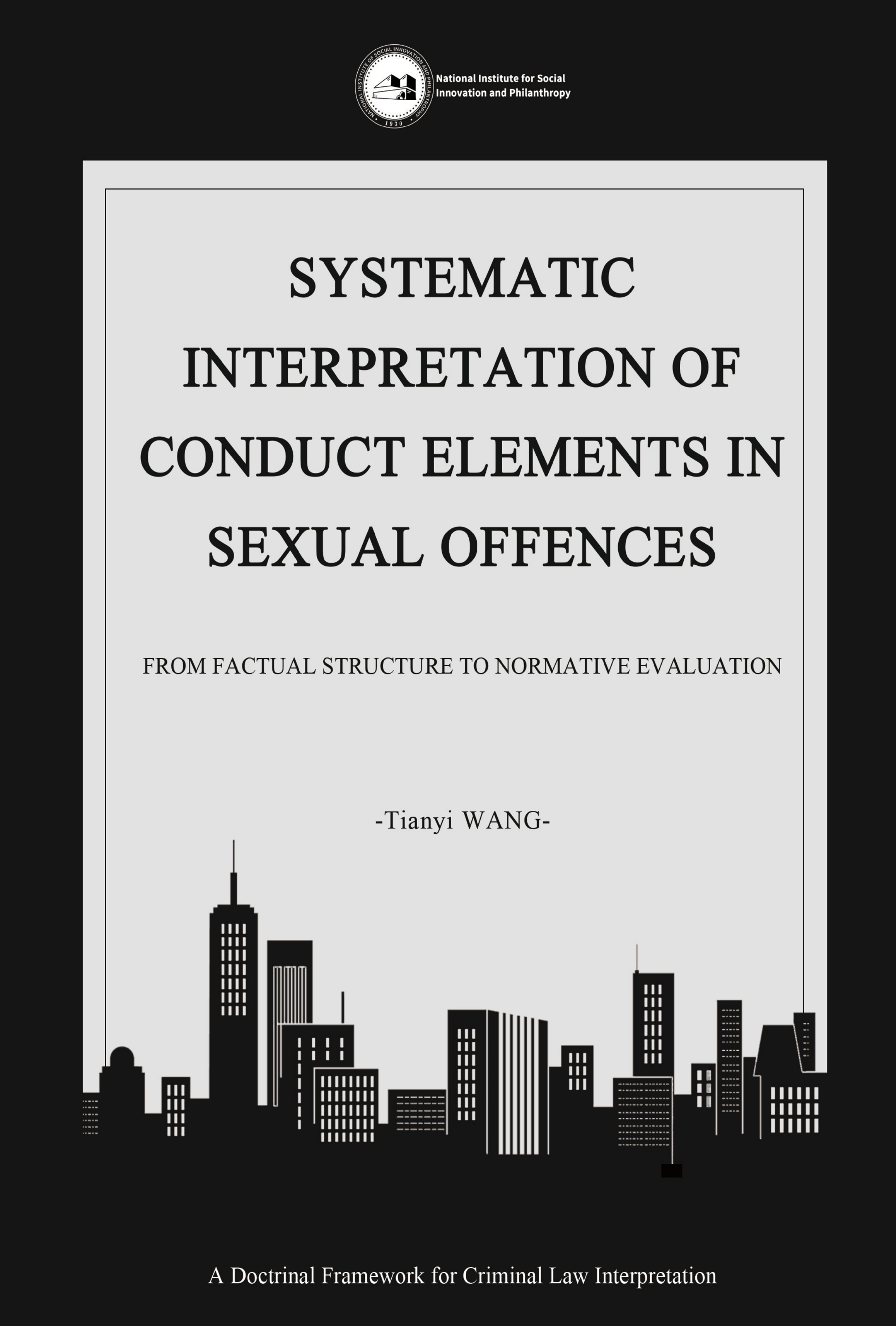
Systematic Interpretation of Conduct Elements in Sexual Offences
From Factual Structure to Normative Evaluation. A doctrinal legal monograph on the internal architecture of sexual offence law, offence elements, proof structure, and criminal law interpretation.
Book Overview
From factual structure to normative evaluation
Systematic Interpretation of Conduct Elements in Sexual Offences reconstructs sexual offence law from the perspective of criminal law dogmatics: how conduct elements are structured, how factual conduct is distinguished from normative evaluation, and how adjacent offence categories should be interpreted within a coherent system.
The book asks how factually similar sexual conduct can be treated through differentiated offence labels, penalty structures, and normative judgments without collapsing into moral intuition, excessive factual fragmentation, or vague appeals to consent.
Core Thesis
Conduct elements as the bridge between facts, legal interest, proof, and adjudication
Sexual offence law cannot be made coherent merely by refining consent or expanding coercive means. It must reconstruct the internal structure of conduct elements, distinguishing factual conduct, normative evaluation, infringement intensity, and offence mapping.
The book stabilizes a unified factual core for completed sexual conduct while avoiding both over-expansion and excessive fragmentation.
The victim’s will is reconstructed as a normative object whose infringement may occur through coercion, incapacity, situational constraint, or dependency.
Terms such as rape, sexual exploitation, and coercive intercourse are treated as tools of normative allocation within the offence system.
The book proposes layered proof: factual conduct determination, normative triggers, attribution of will infringement, and offence mapping.
Structure of the Book
Five-part doctrinal architecture
The book is organized into five major parts and twelve chapters, moving from methodology to factual structure, normative evaluation, adjudicative reasoning, and comparative law.
Methodology and Legal Interests
- Normative preconditions of systematic interpretation
- Sexual autonomy as a structural legal interest
- Completed sexual offences and factual unity with normative differentiation
Conduct Elements and Victim’s Will
- Factual elements, normative elements, and patterns of conflation
- Sexual intercourse as the factual core of conduct elements
- A graded model of will infringement beyond binary consent
Adjudication and Comparative Law
- Systematic differentiation among adjacent sexual offences
- Layered proof and judicial reasoning
- Civil law and common law systems as structural calibration
Author Profile
Tianyi WANG
Tianyi WANG is a legal scholar specializing in criminal law studies, with academic training across mainland China and Taiwan region of China. His research focuses on criminal law dogmatics and comparative criminal law, especially the interpretation of offence elements, attempt doctrine, bribery offences, and the governance of telecommunications fraud.
He currently serves as a lecturer and master’s supervisor at the Law School of Liaoning University, with academic and professional appointments connected with criminal law societies, procuratorial institutions, and legal education evaluation.
Recommended Readers
For criminal law and legal interpretation readers
The book is suited for scholars, postgraduate law students, judges, prosecutors, defense lawyers, and researchers interested in criminal law theory, sexual offence doctrine, comparative criminal law, legal interpretation, and offence-element analysis.
Editorial Note
A specialized work of doctrinal reconstruction
This book takes a field often dominated by moral, political, and evidentiary controversy and brings it back to the architecture of criminal law itself. It shows how conduct elements can provide a stable factual core, how the victim’s will can be understood as a normative object, and how adjacent offences can be differentiated without losing doctrinal coherence.
Its broader significance lies in asking how criminal law can preserve legality, proportionality, interpretive discipline, and normative transparency in one of the most sensitive fields of criminal adjudication.