
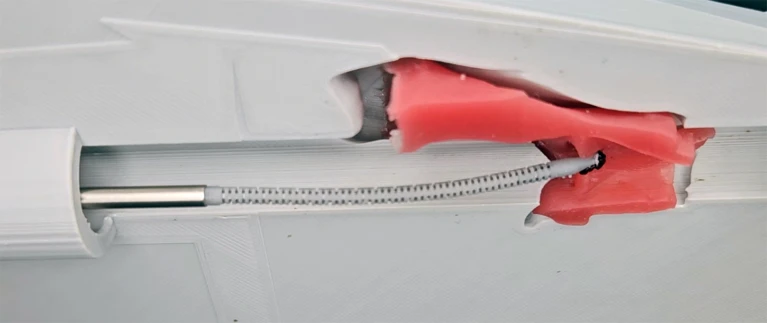
Inspired by the grace and flexibility of the world’s largest land animal, a team of scientists has developed what they describe as the smallest 3D bioprinter ever created. This groundbreaking invention, featuring a printhead just 2.7 millimeters wide attached to a long, flexible robotic arm that mimics the movements of an elephant’s trunk, could transform the future of surgical medicine. The miniaturized bioprinter has the potential to assist doctors in repairing delicate internal tissues by precisely delivering healing hydrogels after surgical procedures.
According to a study published on October 29 in the journal Device, the research team demonstrated that their innovative tool could be inserted through a surgeon’s endoscopic scope and used to apply hydrogel directly onto artificial vocal cords. This advancement marks a major step forward in the field of bioprinting, which has historically been limited to external tissue applications. Ibrahim Ozbolat, a biomedical engineer at Pennsylvania State University, emphasized the significance of this achievement, explaining that while bioprinting has long been used to treat skin defects externally, reaching internal defects safely and effectively has remained a major challenge.
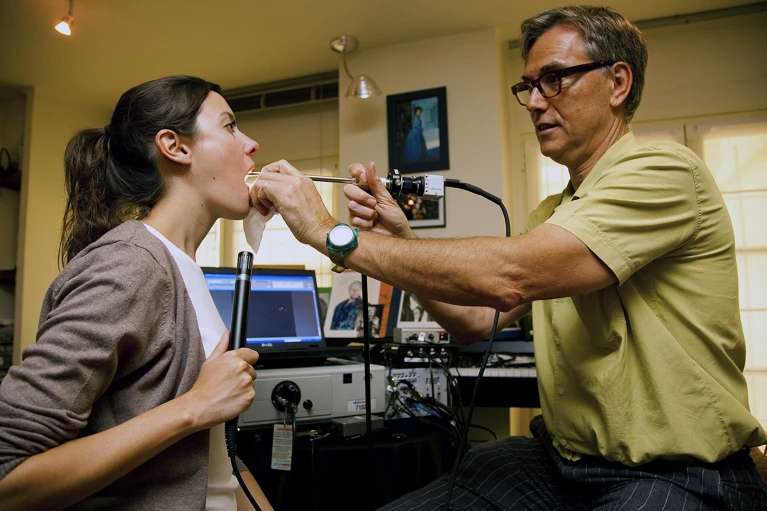
One of the key motivations behind this research stems from the complications many patients experience after surgery on their vocal cords. When cysts or growths are removed, scar tissue can form, making the vocal folds stiff and impairing speech. Hydrogels—soft, water-based biomaterials—have shown great promise in accelerating healing by mimicking the structure of vocal cords and supporting the growth of new tissue. However, surgeons often struggle to deliver these materials accurately due to limited visibility inside the throat. This technical barrier inspired the team to turn to nature for solutions, leading them to the incredible flexibility and precision of an elephant’s trunk as a model for their design.
Swen Groen, a biomedical engineer at McGill University in Montreal and one of the project’s lead researchers, sought to adapt this natural movement into a robotic form that could operate in extremely tight spaces without obstructing a surgeon’s view. The team first created a prototype with an 8-millimeter diameter, but to make it compatible with the narrow surgical scopes used in real procedures, they worked painstakingly to reduce its size. The result was a refined design capable of fitting through a one-centimeter-wide scope, allowing for delicate and targeted hydrogel delivery into synthetic vocal folds. Groen explained that miniaturizing the bioprinter was the most time-consuming part of the project, as it required balancing precision, flexibility, and stability in a space smaller than a human fingertip.
Currently, the tiny bioprinter is manually operated using a PlayStation controller, enabling the operator to guide its movements with remarkable precision. While this approach demonstrates the system’s capability, the researchers aim to enhance its autonomy in the next stage of development. They envision programming the device to interpret images of the surgical site, allowing it to follow pre-defined printing paths automatically. This level of automation could make the technology safer, faster, and more reliable for complex medical applications.
Ozbolat, who has long studied tissue engineering, noted that the upcoming challenge will be adapting the bioprinter for animal testing, which is a required step before human trials can begin. The device may need to be resized or slightly redesigned depending on the anatomy of the test subjects, whether they are monkeys, rats, or other species. Such testing will be crucial to ensuring that the bioprinter can perform effectively in living tissue and under real surgical conditions.
Beyond its use in vocal cord repair, the research team sees broad potential for the elephant-inspired bioprinter across various medical fields. The same flexible robotic arm that enables it to deposit hydrogels could also be used to manipulate other surgical tools such as scalpels or forceps. In procedures where space is limited—such as inside the throat, brain, or abdominal cavity—traditional instruments can be difficult to control with precision. Integrating these functions into a single, highly maneuverable device could revolutionize minimally invasive surgery by improving accuracy and reducing trauma to surrounding tissues.
Luc Mongeau, a co-author of the study and a mechanical engineer at McGill University, highlighted the exciting versatility of this technology. He suggested that by expanding the bioprinter’s capabilities to include both tissue printing and surgical manipulation, doctors could gain an unprecedented level of control in complex operations. The potential applications extend far beyond the vocal cords, possibly including regenerative treatments for other internal organs or delicate reconstructive procedures in areas that are currently difficult to access.
The elephant-trunk-inspired bioprinter represents a remarkable intersection of biology, robotics, and medicine. By studying how nature achieves flexibility and precision, researchers have created a tool that could one day redefine surgical repair and tissue regeneration. Though the project remains in its experimental stages, its success demonstrates how biomimicry—drawing design inspiration from natural forms—continues to push the boundaries of medical innovation. If future tests confirm its safety and effectiveness, this miniature bioprinter may become a vital instrument in the operating rooms of tomorrow, helping physicians heal patients with a level of precision once thought impossible.



Leave a Reply