
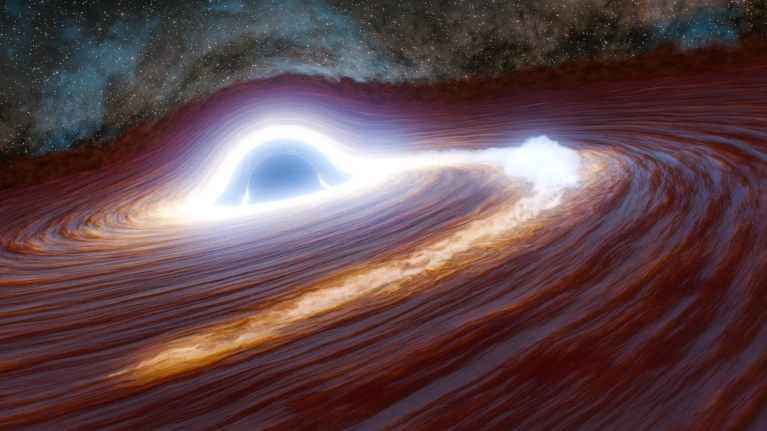
Black holes rarely reveal their secrets, but when they do, the universe puts on a dramatic show. Recent astronomical observations suggest that one of the brightest cosmic flares ever recorded was triggered by a black hole consuming a massive star. This extraordinary burst of light, at its peak, shone more than ten trillion times brighter than the Sun—an intensity that stunned researchers and reshaped assumptions about how black holes draw energy from their surroundings.
The discovery, reported in the scientific journal Nature Astronomy on November 4, highlights one of the rare moments when a black hole’s violent appetite becomes visible across the cosmos. While these objects are often described as cosmic vacuum cleaners, quietly devouring nearby matter, this event shows that sometimes, their galactic dining can produce a spectacular and unexpected light show.
A mysterious flash across the universe
The story began in 2018, when astronomers noticed an unusually bright object in the sky. At first glance, the signal did not seem particularly remarkable. Researchers used the 200-inch Hale Telescope at the Palomar Observatory in California to collect early data, hoping to uncover something groundbreaking. Yet initial readings seemed underwhelming, leading scientists to believe the object was just another flare of moderate interest.
Matthew Graham, an astronomer at the California Institute of Technology and one of the study’s authors, recalls that early impression clearly. When the data first came in, he and his colleagues did not realize they were witnessing one of the most extreme astrophysical events ever observed. The flare’s true nature remained hidden behind what initially looked like ordinary behavior.
Years passed, and the object never fully faded. Typically, bursts of light associated with black holes fade within months. But this one continued to shine intensely, drawing renewed curiosity. The persistence of the flare raised questions that could not be ignored.
A closer look changes everything
By 2023, researchers decided to investigate again, this time with the powerful telescopes at the W. M. Keck Observatory in Hawaii. That deeper look revealed a staggering detail: the flare came from a point roughly 10 billion light years away. For light from such a distant location to appear so bright, the event must have been extraordinarily energetic—far beyond anything astronomers had seen from a black hole before.
Further analysis showed that this flare was at least 30 times brighter than any previously known burst linked to a black hole. The sheer intensity suggested that something catastrophic and rare had taken place.
Scientists explored multiple possibilities. One theory was that the light was an optical illusion caused by gravitational lensing, a phenomenon where gravity bends light and magnifies distant objects. Another hypothesis considered whether a nearby supernova—a powerful exploding star—might have contributed to the brightness. Yet neither explanation matched the data.
The more researchers looked, the clearer the picture became: a massive star had likely wandered too close to a supermassive black hole and been violently torn apart.
When stars fall into darkness
Black holes have tremendous gravitational pull, strong enough to distort space and shred stars that approach their boundaries. This destructive process, called tidal disruption, releases enormous amounts of energy. As the unfortunate star was stretched and ripped apart, jets of gas and radiation were launched outward at extreme speeds, lighting up the universe like a cosmic beacon.
The star involved in this case was colossal—estimated to be at least 30 times the mass of the Sun. As it fell victim to the black hole’s gravity, the resulting jet of energy flared more than 40 times brighter than before, producing the record-breaking burst astronomers eventually recognized.
Even more intriguing, the flare has not yet faded. Researchers believe that remnants of the star are still being consumed. This suggests that the final collapse and disappearance of the star may still be unfolding, offering scientists a rare real-time glimpse into the deadly feeding habits of a black hole.
What astronomers hope to learn next
Researchers around the world are watching closely. Joseph Michail, an astronomer with the Harvard and Smithsonian Center for Astrophysics, says he is eager to see how the flare evolves. Will the brightness gradually dim, signaling the end of the star’s destruction? Or could it surge again as the black hole’s radiation interacts with surrounding dust and gas?
Michail believes that similar events may become easier to detect in the coming years as new sky surveys and powerful observatories expand humanity’s ability to monitor distant cosmic regions. What once seemed like an extremely rare cosmic occurrence may turn out to be far more common, simply hidden by the limits of past technology.
A slow-motion cosmic feast
Perhaps the most striking element of this discovery is the time scale. Because the black hole is so far away, light from the event takes billions of years to reach Earth. Even more surprising, the distance creates another effect: from our perspective, the destruction of the star appears to unfold at a quarter of its real speed. In other words, every two years of activity near the black hole take about seven years to be observed here.
Matthew Graham emphasizes that fully understanding these flares requires patience. With events stretching over years or decades, astronomy becomes a discipline of long-term observation. Scientists must watch the skies continuously, knowing that breakthroughs often come slowly, one data point at a time.
The future of black hole research
This event serves as a reminder that the universe still holds countless mysteries waiting to be uncovered. As telescopes become more advanced and data collection accelerates, astronomers are entering a new era of exploration where once-in-a-lifetime discoveries may become routine.
For now, researchers continue tracking this distant flare, hoping to gain more insight into the extreme processes at the heart of black holes. Each new observation adds a piece to the puzzle, bringing us closer to understanding some of the most powerful forces shaping the cosmos.
And somewhere, across unimaginable distances and timescales, a black hole continues its silent feast—consuming the remains of a star, illuminating the universe, and offering humanity a rare chance to witness the raw energy of the cosmos in action.





Leave a Reply