
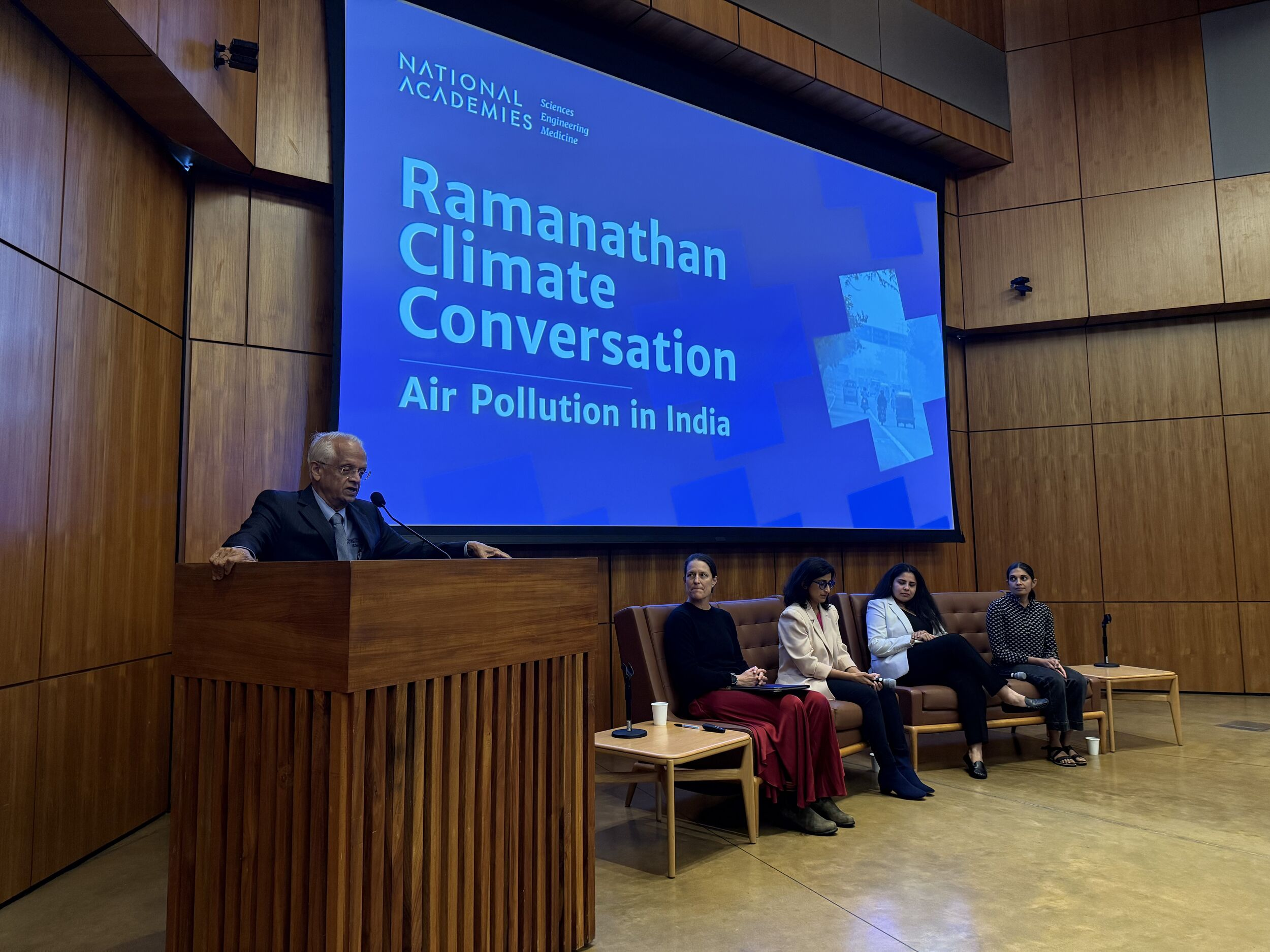
In September, Climate Crossroads participated in RamFest 2025 at the Scripps Institution of Oceanography, a symposium honoring the remarkable career of Veerabhadran Ramanathan, a pioneering figure in climate science, climate action, and a member of the National Academy of Sciences. Spanning a day and a half, the gathering convened an interdisciplinary community of international researchers, policymakers, students, and artists to exchange ideas on climate research and practical solutions. The event served both as a celebration of Ramanathan’s legacy and as a platform for forward-looking conversations on some of the world’s most urgent environmental challenges.
Among the featured programs was the 4th annual Ramanathan Climate Conversation, organized by the National Academies, which introduced fresh perspectives through a focused discussion on air pollution in India. Closely aligned with Ramanathan’s lifelong work, the session titled “Air Pollution in India” embodied the spirit of the Climate Conversations by bringing together experts from different fields to examine a problem situated at the crossroads of public health and climate resilience in South Asia. Moderated by Jennifer Burney of Stanford University, the panel addressed the layered and interconnected nature of India’s air quality crisis, highlighting how environmental, economic, and social factors are deeply intertwined rather than isolated.
This discussion formed part of Climate Crossroads’ broader regional engagement strategy, an ongoing effort to foster interdisciplinary dialogue that supports science-based policymaking and real-world decision processes.
Air Pollution Anywhere Is Air Pollution Everywhere
Air pollution in India is a persistent challenge with consequences that are both visible and hidden, affecting daily life for billions of people. Ramanathan has long emphasized that air pollution does not respect borders, often summarizing the issue with the phrase, “air pollution anywhere is air pollution everywhere.” Emissions from energy production, industrial activity, agriculture, and household cooking all contribute to degraded air quality. As a result, solutions cannot be narrowly defined, as they intersect with public health outcomes, food systems, economic growth, and climate change, creating a dense network of trade-offs that policymakers must navigate.
The invited panelists examined these intersections in depth, offering insights into how scientific evidence and policy design can be translated into effective, on-the-ground action.
Perspectives from Health, Agriculture, and Political Economy
Both outdoor and indoor air pollution exposure contribute to millions of premature deaths each year in India, as well as widespread chronic illnesses including cardiovascular disease, respiratory conditions, cancer, and diabetes. On average, life expectancy is reduced by approximately five years. Pallavi Pant, an environmental health scientist at the Health Effects Institute, explained that declining population health also undermines economic productivity and places heavy strain on the healthcare system. She emphasized the importance of building health systems that are better equipped to respond to pollution-related illnesses as they emerge.
Meha Jain, an associate professor at the University of Michigan, focused on the role of agriculture in worsening air quality. Practices such as crop residue burning, often used to quickly prepare fields for the next planting season, can account for as much as 75 percent of fine particulate matter, known as PM2.5, during peak periods in major urban regions like the Delhi National Capital Region. While burning helps farmers maximize yields and protect food security, climate pressures and rapid groundwater depletion frequently encourage greater reliance on this practice. Jain highlighted the need for integrated approaches that consider water scarcity, climate variability, food production, and air quality simultaneously in order to identify solutions that deliver multiple benefits.
Building on these themes, Meera Mahadevan, an assistant professor at the University of California, San Diego, examined the political economy of air pollution control and decarbonization. She noted that efforts to address air pollution and climate change together often involve difficult trade-offs, particularly in energy and economic policy. Mahadevan cautioned that poorly designed decarbonization policies risk placing disproportionate burdens on vulnerable populations who are still striving for reliable access to electricity. She stressed the importance of empathy in policy design, arguing that while scientific solutions exist, successful implementation depends on workforce development, institutional capacity, and policies that reflect social realities. She described the challenge as difficult but ultimately manageable.
Encouraging Signs of Progress
Despite the scale of the challenges discussed, the panelists also pointed to meaningful progress driven by new technologies, expanded data access, and community leadership. Mahadevan shared research demonstrating a causal relationship between the election of women leaders at the local level and a significant decline in crop burning. Areas with female leadership experienced a 13 percent reduction in burning practices and a corresponding 40 percent decrease in particulate pollution from these activities. She observed that when decision-makers are equipped with accurate information, communities can drive change themselves, noting that women leaders tend to place greater emphasis on public health outcomes.
Advances in real-time air quality monitoring, satellite-based Earth observation, and improved emissions inventories have also enhanced the ability to identify pollution sources. These data improvements have informed initiatives such as the 2019 National Clean Air Program and strengthened disease surveillance efforts within national health agencies. At the same time, more sophisticated satellite systems are enabling researchers to assess the effectiveness of new agricultural technologies and mitigation strategies.
Key Lessons from the Conversation
The 4th annual Ramanathan Climate Conversation demonstrated how closely air pollution and climate resilience are linked to health systems, agricultural practices, and policy frameworks. Panelists explored governance challenges, the need to align incentives across sectors, and the critical role of local leadership in driving sustainable change. As Mahadevan emphasized, collaboration among diverse stakeholders and flexibility in policy design are essential for achieving durable, long-term solutions.
In closing, the speakers underscored that discussions of climate change and air quality, which have historically proceeded in parallel but separate tracks, must be brought together. Shared pollution sources and reinforcing impacts mean that addressing these issues jointly is more effective than tackling them independently. They also stressed the importance of clearer communication by researchers, whether addressing the general public, national policymakers, or leaders at the village council level. The discussion ultimately reinforced the need for holistic strategies capable of managing the complex trade-offs that define the air pollution and climate change nexus.
Acknowledgments
The Ramanathan Climate Conversations are held annually in honor of Veerabhadran “Ram” Ramanathan and are made possible through the generous support of Sunanda Basu. Recognizing climate change as a global challenge requiring global cooperation, the series focuses on climate resilience in South and East Asia while identifying actionable pathways relevant to policymakers and audiences worldwide.
Climate Crossroads extends its gratitude to the event organizers Yangyang Xu, Kristina Pistone, and Jennifer Burney for the invitation to participate in RamFest, as well as to the Scripps team for their support throughout the event.





Leave a Reply