
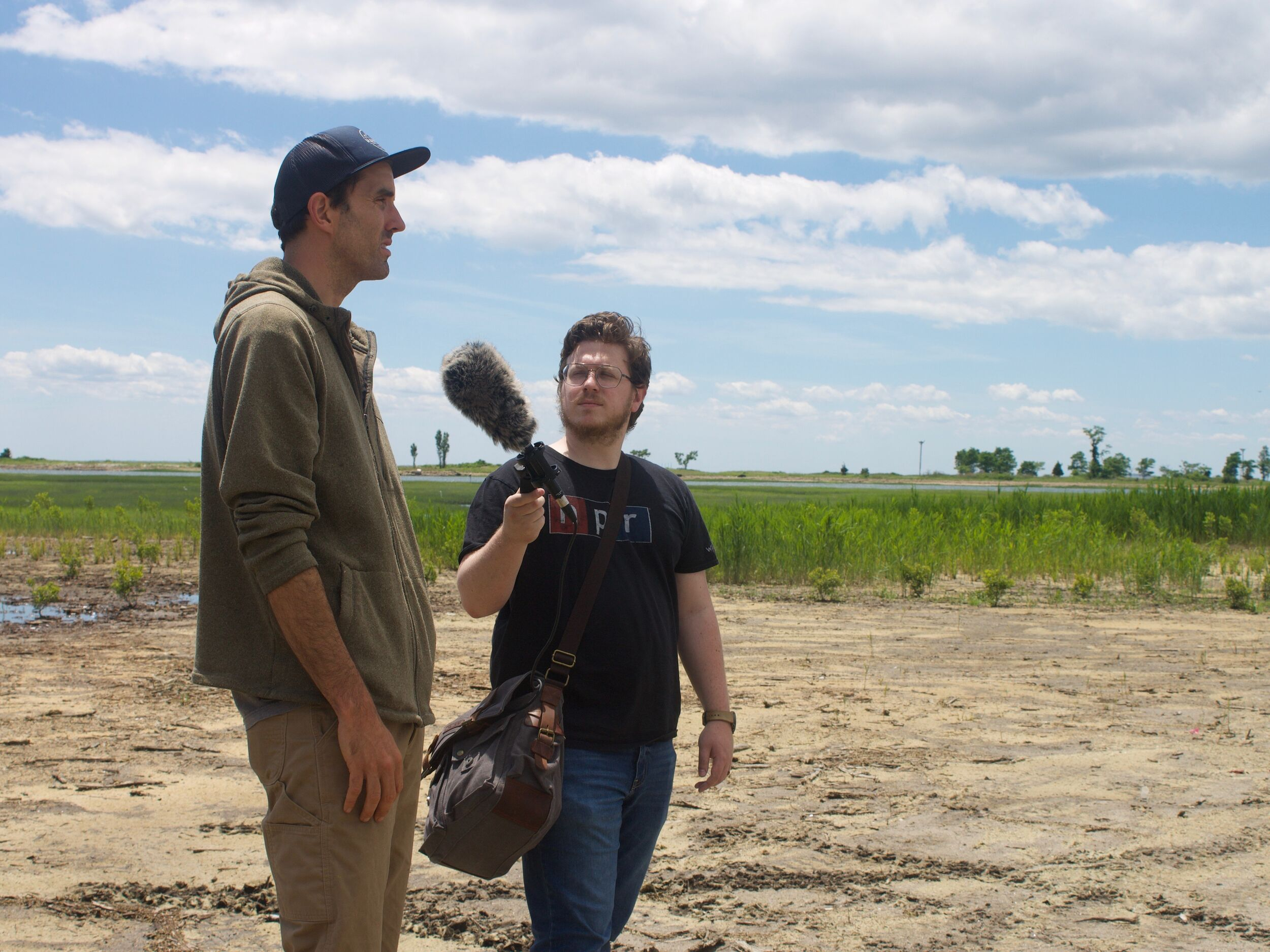
J.D. Allen has spent much of his career telling stories that sit at the intersection of science, society, and public life. Reporting for public radio stations across the northeastern United States, he has investigated the climate crisis, health care, small businesses, and land-use issues for community newspapers on Long Island. Today, he is a lecturer in journalism and science communication at Stony Brook University and co-host of “Higher Ground,” a climate-focused podcast produced by WSHU Public Radio alongside Sabrina Garone. As an accredited trainer with the Solutions Journalism Network, he also works with newsrooms and classrooms to rethink how journalists cover social problems and their responses.
In 2022, Allen received the National Academies’ Eric and Wendy Schmidt Award for Excellence in Science Communications, which recognizes individuals who have made outstanding contributions to making scientific knowledge accessible to the public through creative and impactful storytelling.
Over time, Allen has developed what he calls “civic science media,” a framework that blends rigorous science communication, community engagement, and solutions-focused journalism. Rather than simply explaining scientific findings to audiences, his approach seeks to involve communities in the storytelling process, highlight real-world responses to challenges, and foster meaningful public dialogue.
Allen’s perspective has been shaped by his years in public media. For much of his early career, he followed a traditional reporting model: scientists explained research, journalists translated it, and audiences absorbed the information. But during the COVID-19 pandemic, he began to see how essential local journalism was to communities and how engaged audiences could push for more accessible, practical, and solutions-oriented reporting. Through workshops and collaborations, he refined a set of principles for climate reporting and later integrated them into his teaching at Stony Brook.
His experience in both local and national media has also influenced his storytelling approach. Reporting on sea-level rise in Long Island, he learned that starting with lived experiences — such as flooded basements in specific neighborhoods — made abstract scientific concepts more relatable. Even for national audiences, he believes that concrete, place-based stories are crucial to meaningful engagement.
At the heart of his work are three guiding pillars: making research accessible without oversimplifying it, documenting real-world responses to problems, and engaging communities as partners rather than passive subjects. This framework has proven effective. “Higher Ground” has been broadcast on more than 100 stations for three consecutive years, earning national recognition not because the science was simplified, but because listeners could see their own experiences reflected in the stories.
Community participation is central to Allen’s method. In one season of “Higher Ground,” he trained middle school students in audio production, empowering them to investigate climate issues in their own communities. Their questions shaped the reporting in powerful ways, often pushing adults to be more transparent and evidence-based.
Similarly, before producing a recent special on nuclear energy, Allen helped organize a public forum on Governors Island that brought together scientists, policymakers, students, and community members for an open discussion. The concerns raised in that conversation became a roadmap for the reporting that followed.
Allen emphasizes that science communication should respect both the complexity of research and the intelligence of the audience. For his nuclear energy project, he did not avoid technical topics such as radioactive isotopes or energy markets. Instead, he provided clear explanations and real-world examples, helping listeners understand the broader context rather than just simplified conclusions.
His reporting has also been shaped by community perspectives that challenged his own assumptions. Covering environmental justice issues on Long Island, he discovered that many residents were torn between environmental protection and practical concerns about waste management infrastructure. This tension forced him to examine policy trade-offs more carefully and present more nuanced stories.
A key element of his approach is solutions journalism, which goes beyond describing problems to explore how communities are responding. He argues that simply informing people about rising sea levels without showing possible responses can leave audiences feeling anxious and powerless. By highlighting initiatives such as living shorelines and adaptive infrastructure, journalists can provide audiences with a clearer sense of agency.
Evidence plays a critical role in this process. Allen looks for measurable outcomes, community feedback, and comparative analysis to assess whether solutions are truly effective. He is less interested in good intentions than in demonstrable impact.
His recent focus on nuclear energy emerged from three converging trends: major technology companies investing heavily in nuclear power, deep divisions within the environmental community over its role in decarbonization, and growing student interest in the topic. In his classes at Stony Brook, students frequently raise questions about nuclear energy as they grapple with the realities of the climate crisis.
The project was developed in collaboration with Heather Lynch, director of Stony Brook’s Collaborative for the Earth, as well as experts from institutions including Georgia Tech, NYU, and the New York Climate Exchange. This interdisciplinary partnership ensured that scientific rigor was embedded throughout the reporting process.
For Allen, success is not about persuading everyone to agree on nuclear power. Instead, he hopes listeners will come away with a deeper understanding of the trade-offs involved and a greater willingness to engage thoughtfully with complex issues.
Ultimately, he wants audiences to feel empowered rather than overwhelmed by science. His message to other science communicators is clear: avoid doom-driven narratives, treat communities as collaborators, and trust audiences to handle complexity when it is presented with clarity and respect.
This approach, he believes, represents the future of civic science media — journalism that informs, engages, and strengthens public participation in scientific debates.




Leave a Reply