
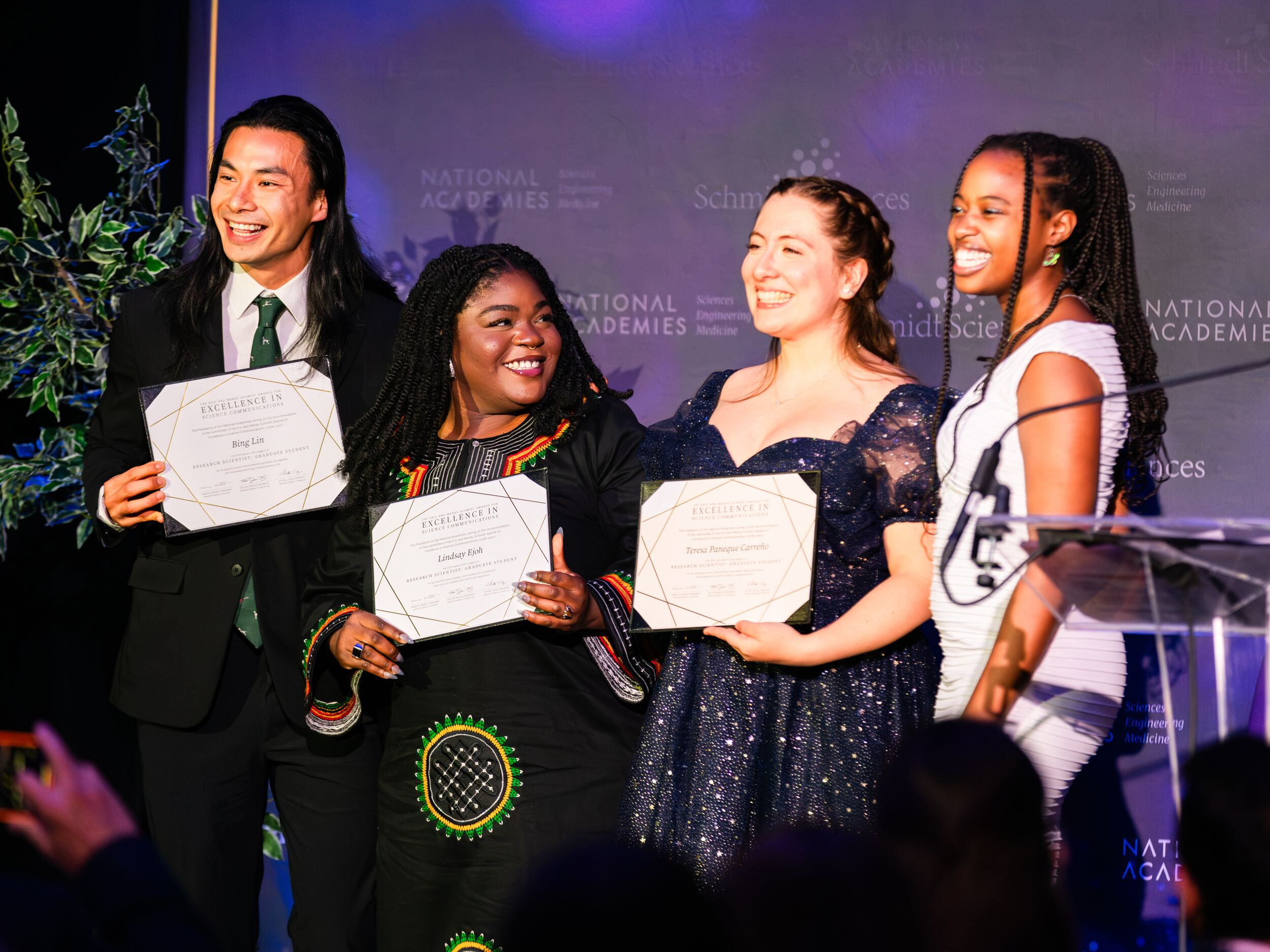
The National Academies of Sciences, Engineering, and Medicine have officially opened the call for entries for the 2026 Eric and Wendy Schmidt Awards for Excellence in Science Communications. Organized in collaboration with Schmidt Sciences, the awards program has entered its fifth year and continues to spotlight individuals who bring clarity, creativity, and rigor to public conversations about science, engineering, and medicine.
Since its launch, the initiative has honored outstanding science communicators, journalists, and research scientists whose work makes complex scientific topics accessible to broad audiences. By recognizing original storytelling and thoughtful public engagement, the awards aim not only to celebrate achievement but also to strengthen a growing network of professionals committed to improving the public’s understanding of science. Previous recipients have come from diverse disciplines and career stages, illustrating the wide reach and influence of science communication across society.
For 2026, a total of 24 awards will be presented, with combined prize funding of $640,000. The program is designed to recognize individuals who are actively working at the forefront of science communication or journalism and whose creative efforts in 2025 addressed major developments or challenges in science, engineering, or medicine. Special consideration will be given to applicants whose current career stage or professional context suggests that this recognition could meaningfully advance their future trajectory.
In addition to financial support, Schmidt Sciences will work to nurture a dynamic and collaborative community among award recipients. Through partnerships with leading journalistic institutions, awardees will gain access to professional development and training opportunities intended to further elevate their impact and leadership within the field.
Marcia McNutt, President of the National Academy of Sciences, emphasized the broader importance of the awards, noting that effective science communicators do more than share information. They stimulate curiosity, deepen public understanding, and help bridge the divide between cutting-edge research and everyday life. By highlighting individuals who communicate with clarity and integrity, the program seeks to reinforce public trust in science and inspire future generations to engage with scientific inquiry.
James Ricci, director of science systems at Schmidt Sciences, described science communication as essential infrastructure for a healthy and informed society. Through its partnership with the National Academies, Schmidt Sciences aims to support communicators and researchers who can transform technical complexity into accessible knowledge and ensure that communities everywhere can benefit from scientific progress.
Megan Ranney, chair of the selection committee and dean of the Yale School of Public Health, underscored the human dimension of science communication. She observed that meaningful communication is rooted in connection—when researchers and journalists approach communities with openness and respect, science becomes more responsive to lived experiences and more capable of serving the public good. The awards, she explained, celebrate those who build trust, foster dialogue, and empower communities to use science as a shared tool for understanding and problem-solving.
The 2026 awards will recognize work produced or released in 2025 that explores scientific advances or pressing issues in science, engineering, or medicine for a general audience. Eligibility is organized into three primary categories: Research Scientists, Science Journalists, and Science Communicators.
Nine awards will be granted to Research Scientists, divided into three subcategories based on career stage. Graduate student researchers must have been enrolled as master’s, M.D., or Ph.D. candidates engaged in active research during 2025. Early-career researchers must have been practicing scientists fewer than ten years beyond their master’s, M.D., or Ph.D. degree. Later-career researchers must have had ten or more years of professional experience following completion of their advanced degree.
Another nine awards will be presented to Science Journalists across three subcategories. Local or regional journalists must have been based in a specific locality or region and produced work focusing on local issues or examining how broader scientific developments affected their communities. Early-career journalists must have had five or fewer years of professional journalism experience. Freelance journalists must have been self-employed while producing science journalism for publication.
Six awards will be dedicated to Science Communicators who are not primarily identified as science journalists or practicing research scientists but who have contributed meaningfully to public understanding of science. Independent communicators include those producing work on a freelance or contract basis outside formal organizational structures. Organizational communicators are professionals who create science communication content as part of their responsibilities within institutions, using internal resources and operating within established frameworks.
Within each subcategory, one recipient will receive a top prize of $40,000, while two additional honorees will receive recognition awards of $20,000 each. Altogether, the program will distribute $640,000 in prize funding.
The submission deadline for the 2026 cycle is April 3, 2026. Applications will be evaluated by a panel of leading scientists, journalists, and experts in science communication drawn from academic, nonprofit, corporate, and other sectors. Winners are expected to be announced in the fall of 2026.
The Eric and Wendy Schmidt Awards for Excellence in Science Communications are funded by Schmidt Sciences, with additional support from the National Academy of Sciences’ W.K. Kellogg Foundation Fund and the Ralph J. and Carol M. Cicerone Endowment for NAS Missions.
Schmidt Sciences, founded in 2024 by Eric and Wendy Schmidt, is a nonprofit organization dedicated to accelerating scientific discovery and advancing breakthrough research. The organization focuses on areas with strong potential for global impact, including artificial intelligence and advanced computing, astrophysics, biosciences, climate research, and space exploration. Through its science systems program, it also supports researchers across disciplines by strengthening the broader scientific ecosystem.
The National Academies of Sciences, Engineering, and Medicine are private, nonprofit institutions that provide independent and objective advice to inform public policy and address complex national and global challenges. Operating under a congressional charter granted to the National Academy of Sciences in 1863 and signed by President Abraham Lincoln, the organization continues to play a central role in guiding science-based decision-making in the United States.
By continuing to honor excellence in science communication, the 2026 awards program highlights the critical role that communicators, journalists, and researchers play in shaping an informed society. At a time when scientific issues increasingly influence daily life and global stability, initiatives like these reinforce the importance of clear, responsible, and inspiring public engagement with science.




Leave a Reply