On October 15, 2026, MIT News reported new research showing that Antarctica’s towering ice cliffs can retreat substantially faster than existing models predict without necessarily entering a sustained cycle of collapse. Researchers examining satellite observations of more than 15,000 Antarctic ice cliffs found that periods of rapid retreat were followed by stabilization, challenging a longstanding assumption about how exposed glacier fronts contribute to future sea-level rise. The findings were reported in connection with a study published in Science. MIT News
The investigation addresses an important uncertainty in climate science: whether sufficiently tall ice cliffs can initiate a self-reinforcing sequence of failures that accelerates the loss of Antarctic ice. Under the marine ice cliff instability hypothesis, cliffs exceeding a critical height may collapse under their own weight, exposing still taller cliffs farther inland. Previous modeling approaches commonly used a threshold of approximately 100 meters to represent this process. The new observations indicate that cliff height alone cannot adequately explain the behavior researchers measured. MIT Newsnewscientist.com
Four Years of Satellite Measurements Reveal Unexpected Behavior
The research was conducted by scientists associated with the Massachusetts Institute of Technology and Woods Hole Oceanographic Institution, with Caroline Needell, a graduate student in their joint program, among the study authors. The team analyzed measurements collected by NASA’s Ice, Cloud, and Land Elevation Satellite-2, known as ICESat-2. The satellite uses laser altimetry to measure ice surfaces and elevations across polar regions. Its observations provided a broader empirical basis for examining ice cliff stability than earlier approaches relying heavily on theoretical models and limited field observations. MIT Newsnewscientist.com
The dataset covered 2019 through 2023 and included approximately quarterly measurements of more than 15,000 ice cliffs. Across the observations, the average cliff stood about 30 meters tall, substantially below the commonly assumed instability threshold. Cliffs exceeding 100 meters were uncommon, although the satellite detected several examples of exceptional height. Researchers subsequently examined four Antarctic regions containing some of the tallest observed cliffs, including one reaching 127 meters. MIT News
These unusually tall cliffs provided an opportunity to investigate how retreat unfolds when ice approaches or exceeds the height traditionally associated with instability. The researchers observed collapses and glacier retreat occurring faster than their existing marine ice cliff instability models anticipated. However, the episodes did not develop into uninterrupted inland collapse. Instead, retreat subsided and the ice advanced toward the ocean again. The observed behavior therefore combined potentially significant short-term ice loss with processes that interrupted further cliff failure. MIT Newsnewscientist.com
The satellite analysis also identified environmental characteristics associated with stability. Cliffs that remained relatively stationary tended to have thicker accumulations of mélange, the mixture of fragmented icebergs and sea ice collecting in front of glacier margins. Surrounding water depth also appeared relevant because water can provide buoyant support against exposed ice. These relationships indicate that the physical setting of a cliff matters alongside its height, although an observed association between mélange thickness and stability does not independently establish how much protection the mélange provides. MIT News
Another important feature was the terrain beneath the ice. Where the underlying bed rises, the resulting topography can reduce the effective thickness of overlying ice and interrupt retreat. Researchers found stabilization occurring near such elevated features. They also observed that taller cliffs could thin and settle into shorter configurations as they collapsed, reducing their susceptibility to further failure. Together, these observations suggest that ice thinning and underlying topography should receive greater attention in representations of marine ice cliff instability. MIT News
Implications for Sea-Level Forecasting and Scientific Uncertainty
The findings do not establish that runaway ice cliff collapse is impossible. New Scientist’s independent coverage emphasized that future instability depends partly on the shape of the seabed and the rate at which glacier ice flows toward the ocean. Ice flowing outward may thin an exposed cliff sufficiently to restore stability, even when rapid retreat initially occurs. Whether that stabilizing response can consistently outpace ice loss under different future conditions remains unresolved. newscientist.com
Antarctica’s Thwaites glacier illustrates why these limitations matter. According to the secondary reporting, underwater ridges currently contribute to stabilizing portions of the glacier, but continued retreat could eventually expose ice to substantially different seabed conditions. Scientists discussing that possibility described scenarios in which destabilization becomes more serious. Those scenarios are not observed outcomes of the new study, and the available evidence does not establish when, or whether, sustained runaway collapse will occur. newscientist.com
The central scientific distinction is therefore between the speed of individual retreat episodes and the persistence of retreat over time. Faster collapse can increase short-term ice loss, while subsequent stabilization can prevent that initial event from producing a prolonged sequence of failures. The observations challenge simplified model assumptions but do not, by themselves, provide a revised numerical forecast of Antarctic sea-level contributions. Additional evaluation of different glacier settings and their changing physical conditions remains important. MIT Newsnewscientist.com
Relevance to Climate Adaptation and Research Investment
For researchers developing sea-level projections, the study identifies measurable characteristics that may improve how glacier instability is represented: cliff height, underlying terrain, ice thinning, surrounding water and the conditions at glacier fronts. For coastal resilience planners and public-interest organizations, a cautious implication is that adaptation assessments should account for uncertainty in the timing and persistence of Antarctic ice loss rather than treating a single collapse mechanism as an established forecast. This is an application of the scientific findings, not an adaptation policy evaluated by the study. MIT Newsnewscientist.com
The research received partial support from NASA, the U.S. National Science Foundation and the DOMINOS project within the International Thwaites Glacier Collaboration. Its contribution is observational evidence that can inform further scientific investigation, rather than a demonstration of immediate policy outcomes. The remaining challenge is to determine how the stabilizing processes identified in the satellite record will behave as Antarctic glacier conditions continue to change. MIT Newsnewscientist.com
Sources
- Satellite data reveal how Antarctica’s ice cliffs behave over time — MIT News (2026-10-15)
- Towering glacial ice cliffs may collapse in fits and starts — newscientist.com (2026-10-15)
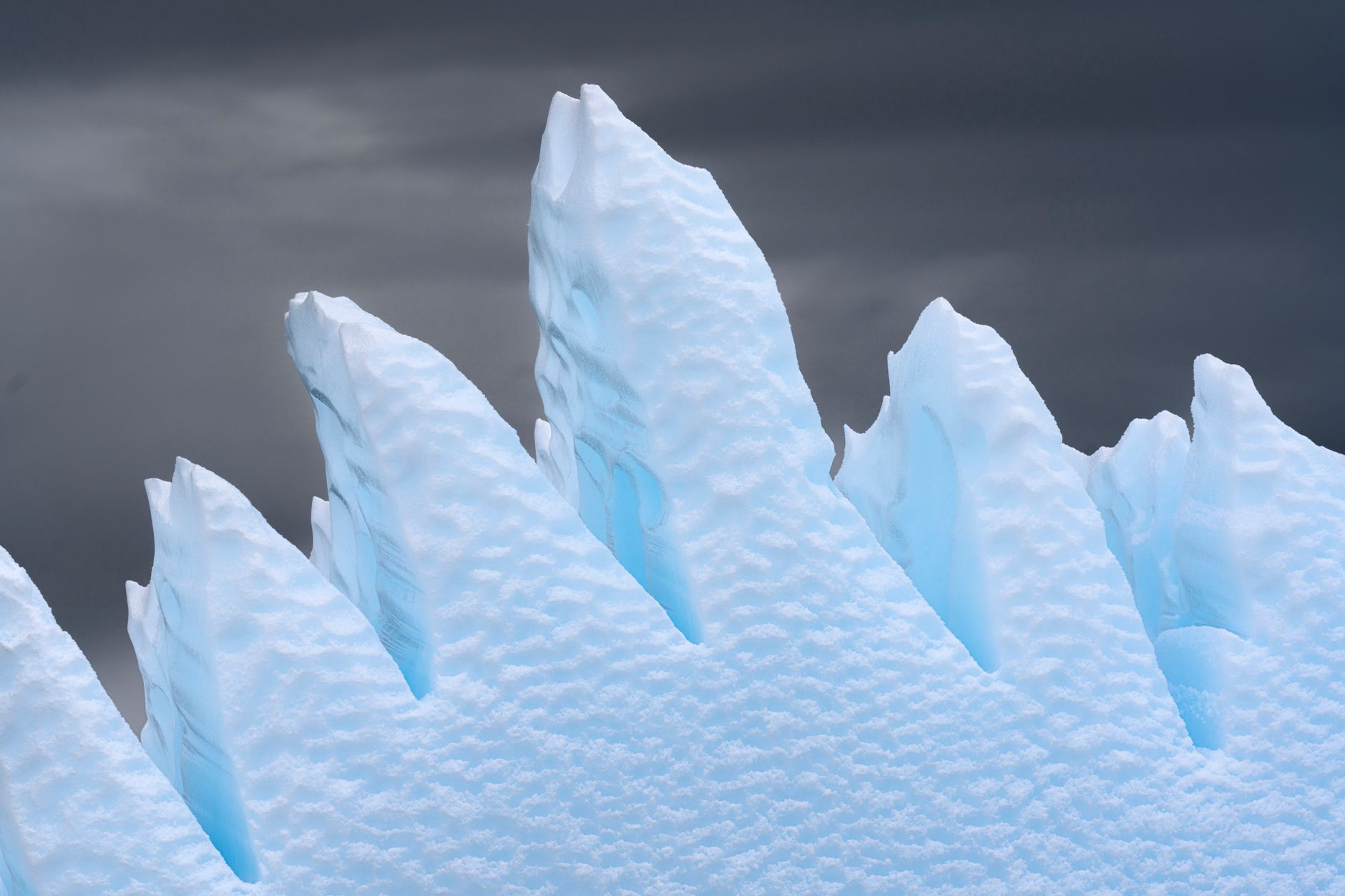
Illustrative stock photograph. Photo: Hugo Sykes / Pexels. Photo source.