
This year, students arriving at Tsinghua University in Beijing encountered a unique first introduction to campus life: it wasn’t a person welcoming them, but an artificial intelligence assistant. Admission letters included a special code granting access to a chatbot designed to answer questions about courses, clubs, and campus living. Meanwhile, at Ohio State University in Columbus, incoming students must now complete mandatory AI courses to ensure they graduate with a fundamental understanding of artificial intelligence. Across the globe at the University of Sydney, Australia, students continue to take in-person examinations to verify that their acquired skills have not been delegated to AI tools.
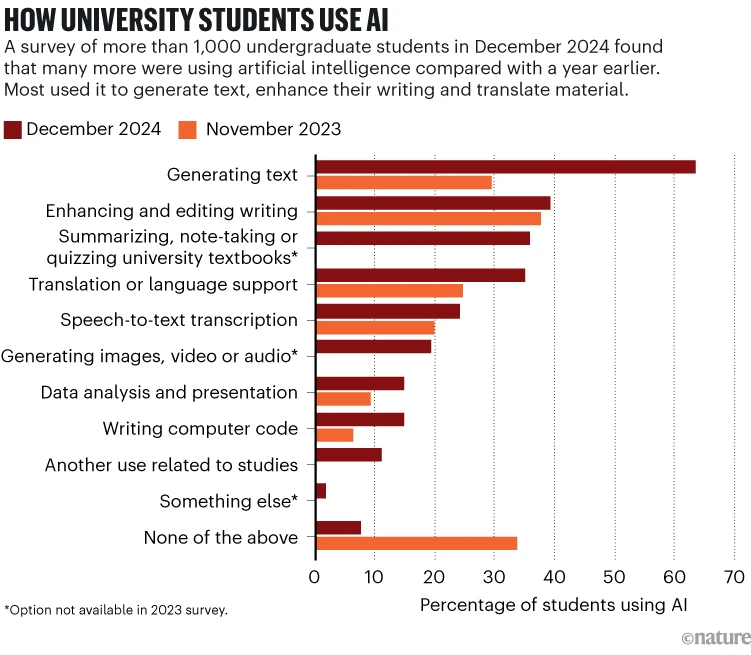
These examples highlight a significant shift in higher education as universities strive to integrate generative AI tools—such as ChatGPT—into their teaching frameworks. These tools, capable of analyzing complex data, answering questions, and producing coherent essays in seconds, challenge traditional educational methods. A 2024 global survey revealed that 86% of university students regularly used AI in their studies, with other polls indicating even higher rates. Marc Watkins, an AI and education researcher at the University of Mississippi, observes that “students are rapidly becoming expert users of these tools.”
For many, AI offers a promising opportunity to enhance learning and prepare students for a rapidly evolving job market. Institutions like Tsinghua and Ohio State have begun embedding AI into coursework, and research suggests these tools can be effective. A randomized controlled trial involving Harvard University physics undergraduates found that students using a custom AI tutor learned more quickly and efficiently than those relying solely on human instruction.
However, concerns are mounting. Educators worry that the rapid adoption of AI may hinder students’ learning, as both instructors and learners struggle to use these tools effectively. There is apprehension that students might rely on AI to bypass assignments, potentially weakening critical thinking and independent problem-solving skills. Some academics also question the ethics of widespread AI adoption, noting that many of these tools are controlled by private companies, with opaque algorithms and uncertain cognitive effects. In June, an open letter signed by over 1,000 scholars globally warned against uncritical use of AI in universities, emphasizing that public funds should not be directed toward profit-driven platforms that could erode students’ skills.
Despite differing views, one thing is clear: AI has arrived in higher education, and rapidly. Shafika Isaacs of UNESCO notes that “the adoption rate of generative AI by students and faculty is outpacing institutional policies, teaching methods, and ethical guidelines.”
The AI Generation in Academia
Universities have a history of adapting to new technologies, from computers to online courses. Yet generative AI presents a unique challenge: not only can it perform tasks central to university teaching, but it is evolving at unprecedented speed. Sue Attewell, head of AI at UK higher education body Jisc, emphasizes, “The difference with AI is the velocity at which it changes.”
Students worldwide are embracing AI at astonishing rates, particularly in STEM fields. In 2025, the AI company Anthropic analyzed one million anonymized conversations between university students and its AI, Claude, and found disproportionate use among students in science, technology, engineering, and mathematics compared with peers in humanities or business. A UK survey of over 1,000 students showed that nearly 90% had used generative AI for coursework or exams, with the majority employing it to explain concepts, refine text, or generate initial drafts.
Many students view AI as a tool to enhance efficiency rather than a means to cheat. “Students often know how to use AI on social media or for daily life, but not academically,” Attewell notes. This gap in knowledge underscores the challenge universities face: how to guide students in using AI responsibly and effectively.
Institutional Responses: Chaos and Coordination
Responses to AI in academia have varied. In the U.S., adoption has been uneven, leaving students exposed to multiple, sometimes conflicting, policies depending on the course. In contrast, Australia has taken a more coordinated approach, partly due to national guidelines developed by the Tertiary Education Quality and Standards Agency since 2023. In China, AI integration in universities is considered a national priority rather than an optional feature, according to Ronghuai Huang of Beijing Normal University.
Faculty adoption of AI also lags behind student usage. Some educators use AI to streamline tasks such as drafting assignment feedback, while others avoid it entirely. A survey of over 1,600 faculty across 28 countries found that around 60% used AI in teaching, yet 80% reported that their institutions provided no guidance on how to do so effectively. George Siemens, a technology and education researcher at the University of South Australia, remarks, “Faculty use is less sophisticated than student use.”
Meanwhile, tech companies aggressively market AI products to universities. OpenAI’s ChatGPT Edu and Google’s AI tools offer campus-wide access, often with data protection assurances. Institutions benefit from these partnerships, yet concerns remain about commercial interests, ethical considerations, and the environmental impact of large AI models.
Innovative AI Platforms
Some universities are proactively integrating AI into their learning environments. At the University of Sydney, biologist Danny Liu developed Cogniti, a generative AI platform embedded in the digital learning system. This allows faculty to create tailored AI teaching assistants, from subject-specific tutors to tools that expand brief feedback into detailed comments. Over 1,000 educators at Sydney and 100 universities worldwide now utilize the platform.
Tsinghua University has similarly expanded AI initiatives. Following ChatGPT’s release, the university developed around 100 AI teaching assistants and implemented a three-layer architecture to integrate multiple AI models while mitigating issues like hallucinations, where AI generates inaccurate content. This system allows students to ask questions about lectures, which are routed through knowledge engines and multiple AI models to provide accurate, up-to-date responses.
Evaluating Learning Outcomes
Despite widespread AI adoption, questions about its impact on learning remain. Early studies suggest mixed results. Tsinghua researchers observed that students using AI tutors initially performed better on tests but scored lower in follow-up assessments weeks later, indicating a possible illusion of understanding. Similarly, MIT researcher Nataliya Kosmyna used EEG to compare brain activity in students writing essays with and without AI. Students relying solely on their own knowledge displayed stronger neural connectivity and better recall than those using AI, suggesting that AI may reduce cognitive engagement.
These studies, while limited, have sparked concern among educators. Many fear that overreliance on AI could erode critical thinking and academic independence. Anthropic’s data analysis showed that nearly half of student-AI interactions involved seeking direct answers with minimal engagement, reflecting potential overuse.
A Balanced Approach
Some experts argue that AI can enhance learning when used thoughtfully. Harvard’s AI physics tutor trial, led by Greg Kestin, demonstrated that active learning combined with AI guidance can improve comprehension. The tutor prompted students to engage with concepts and solve problems rather than passively receiving answers, resulting in higher post-class test scores compared to traditional instruction.
The overarching lesson is clear: AI can either undermine or enhance critical thinking, depending on its use. The challenge for universities is to guide students toward applications that promote learning, reasoning, and problem-solving rather than mere convenience.
Redefining Higher Education
Assessment strategies are evolving. The University of Sydney now employs a dual system: supervised assessments to verify skills, and unmonitored exercises where students may use AI freely. This approach encourages skill development while maintaining academic integrity.
Looking ahead, many educators predict a shift from content memorization to developing judgment, critical analysis, and collaboration with AI. Michael Gerlich of the Swiss Business School notes, “Universities that teach students to design, critique, and collaborate with AI will remain essential in the workforce.”
Strong leadership from universities is crucial. Researchers caution against uncritical partnerships with tech companies and advocate for standards that safeguard ethics, privacy, and educational value. Siemens warns that without strategic oversight, universities risk ceding influence to profit-driven organizations, emphasizing the sector’s responsibility to shape AI deployment in socially and academically meaningful ways.
In short, AI is transforming higher education in profound ways. Its potential to enhance learning is immense, but so are the risks. Universities face the task of balancing innovation with critical oversight, ensuring that AI becomes a tool that strengthens, rather than diminishes, the intellectual growth of students worldwide.




Leave a Reply