
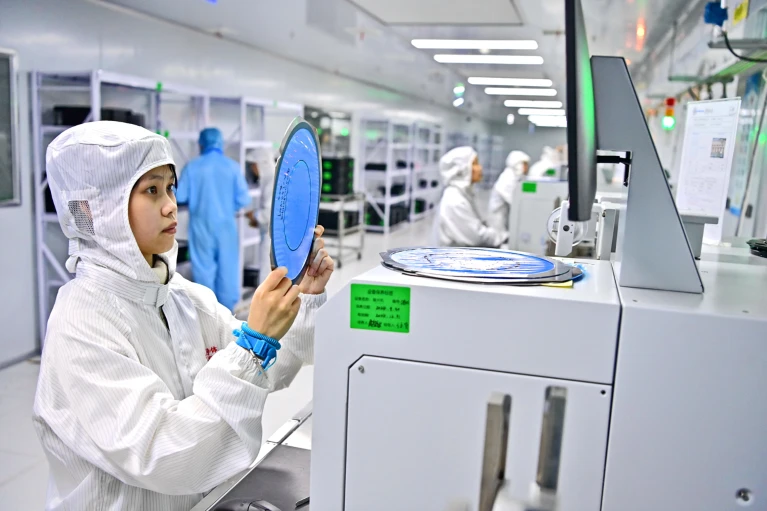
China’s top leadership gathered in Beijing this week to outline the nation’s 15th Five-Year Plan (FYP), which will guide the country’s development from 2026 to 2030. The meeting set the stage for a new era of innovation-driven growth, focusing heavily on scientific self-reliance, the advancement of core technologies, and the acceleration of high-tech industries.
According to the communiqué released after Thursday’s meeting, the new plan will prioritize breakthroughs in science and technology, as well as the cultivation of key strategic sectors. It is expected to be officially unveiled in early 2026, marking a pivotal moment in China’s long-term push toward global technological leadership.
Yin Hejun, China’s Minister of Science and Technology, emphasized during a Friday press conference that Beijing will increase investment in advanced semiconductor technologies, artificial intelligence (AI), and fundamental research. These areas, he said, are central to overcoming the technological barriers that have constrained the nation’s industrial advancement in recent years.
Huang Baorong, a sustainable development policy researcher at the Chinese Academy of Sciences, expects that the government will significantly raise its science-related spending over the next five years. This, he noted, could offset the potential impact of declining U.S. federal research funding in key global fields such as climate science and public health.
China’s investment in research and development (R&D) has expanded dramatically over the past two decades. In 2024, R&D spending surpassed 3.6 trillion yuan (about US$505 billion), representing an 8.9% increase from the previous year and nearly six times the level recorded in 2009. With these figures, China remains the largest R&D spender in the world — a reflection of its determination to close the innovation gap with leading Western economies.
Tackling Semiconductor Bottlenecks
One of the most urgent challenges outlined in the upcoming plan is semiconductor independence. Hu Guangzhou, an economist at the China Europe International Business School in Shanghai, noted that a substantial portion of China’s new investments will likely target the elimination of technological bottlenecks in advanced chip manufacturing.
Semiconductors power everything from consumer electronics to infrastructure and defense systems. They have also become the focal point of an intense U.S.–China technological rivalry. Washington has imposed strict export restrictions on China’s access to advanced chips, as well as the machinery and expertise required to produce them, citing national security concerns.
For China, achieving chip independence is not just a technical goal—it’s a strategic imperative. Dou Qiang, chief scientist at Tianjin-based Phytium Technology, said on state-run China National Radio that the coming decade will be decisive. “With another five to ten years of concentrated effort,” he said, “we may be able to leapfrog Western competitors in critical chip technologies.”
AI at the Heart of China’s Innovation Drive
The push for semiconductor innovation also underpins another priority area in the 15th FYP—artificial intelligence. As one of the most transformative technologies of the 21st century, AI is expected to remain a cornerstone of China’s science and technology strategy.
Minister Yin revealed that the government will craft a comprehensive national framework for AI development. This framework will aim to enhance research in new AI models, expand computing power, and ensure the integration of AI across industries.
Philipp Boeing, an innovation economist at Germany’s ZEW–Leibniz Centre for European Economic Research, explained that China’s AI policy differs from that of the United States. “While the U.S. is focused on producing the best AI models in the world, China’s approach is to deeply integrate AI into its economic and industrial systems,” he said.
China’s “AI+” initiative, launched in August, reflects this vision. It seeks to fuse artificial intelligence with key sectors such as manufacturing, healthcare, and transportation by 2035. In addition to AI, the upcoming plan is also expected to emphasize next-generation technologies such as humanoid robotics, 6G communications, and clean energy innovations.
Competing for Global Talent
Beyond its domestic goals, the 15th FYP may reshape global research mobility. As funding pressures mount in U.S. universities and research institutions, many scientists are considering opportunities abroad—an opening that Chinese policymakers are eager to seize.
“China has a unique chance to attract top researchers, particularly those of Chinese origin who wish to return,” said Boeing. Over the past year, several prominent China-born scientists have returned home, including Liu Jun, formerly a mathematician at Harvard University, and Su Fei, a former chip architect at Intel in California.
While it may take years and significant resources for these returnees to make a major impact, their presence signals a growing confidence in China’s research environment. Yu Jie, a China expert at Chatham House in London, noted that the influx of returning scientists could help strengthen China’s domestic research capacity and reduce reliance on Western institutions.
To further attract talent, China recently introduced a new visa category designed specifically for foreign scientists and researchers in science, technology, engineering, and mathematics (STEM). This move underscores the country’s ambition to position itself as a global hub for innovation.
Building Global Scientific Influence
However, experts caution that becoming a true global leader in science requires more than funding and talent recruitment. Joy Zhang, a sociologist at the University of Kent, argues that scientific leadership also involves the ability to shape international policy and ethical standards in emerging technologies.
“China has made remarkable progress in research capacity and innovation,” Zhang said, “but global influence depends on guiding the moral and regulatory debates at the frontiers of discovery. That is a skill China still needs to develop and demonstrate.”
As the nation prepares to implement its 15th Five-Year Plan, the stakes are high. The years from 2026 to 2030 will determine whether China can transform its vast investments and industrial ambitions into genuine global leadership in technology and innovation. With its renewed focus on AI, semiconductors, and scientific self-reliance, Beijing’s strategy signals not just economic ambition—but a bid to redefine the future of global science.




Leave a Reply