
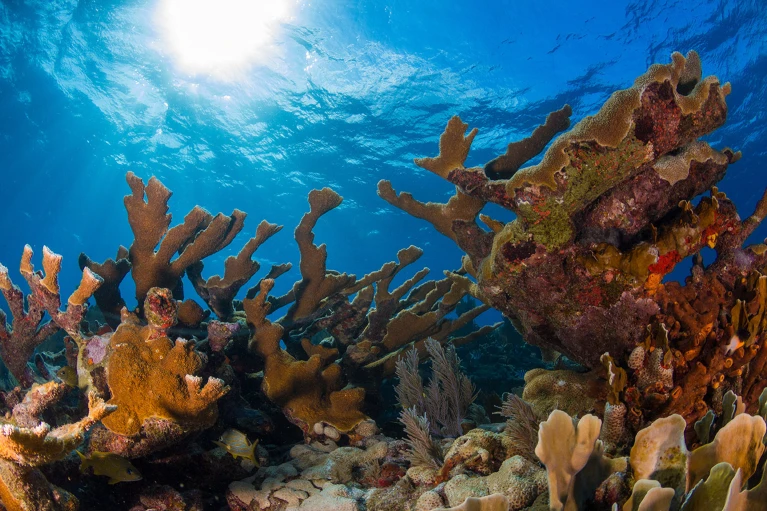
Two years after an unprecedented heatwave swept through Florida’s coastal waters, scientists have confirmed a sobering reality: two of the state’s most iconic corals, which have thrived along its 560-kilometer-long reef for more than 10,000 years, are now considered ‘functionally extinct’ in southern Florida.
The elkhorn coral (Acropora palmata) and staghorn coral (Acropora cervicornis), once the primary architects of Florida’s reefs, still exist in scattered locations and laboratory tanks. However, a study released today in Science indicates that their population has dwindled to such an extent that they no longer perform their essential ecological role as reef builders.
“This ecosystem has been permanently altered,” explains Ross Cunning, a coral biologist at the John G. Shedd Aquarium in Chicago and co-author of the study. While he stresses that scientists have not abandoned hope for these species, he emphasizes that future conservation strategies must undergo a fundamental transformation.
A Reef Under Stress
Over the past several decades, Florida’s coral reefs have faced repeated bleaching events. Coral bleaching occurs when elevated water temperatures force corals to expel the algae that provide them with nutrients and color, leaving them weakened and vulnerable. The 2023 heatwave, which coincided with record-breaking global temperatures, struck Florida earlier, faster, and more intensely than any previous event.
During this period, water temperatures remained above 31 °C for nearly 41 days, reaching up to 4 degrees Celsius above normal in some areas. The prolonged heat exposure was two to four times higher than any prior recorded extremes. While many corals survived, mortality among Acropora corals ranged from 98 to 100 percent across large stretches of the reef, from Dry Tortugas National Park in the west through the Florida Keys to the east. In regions near Miami and further north, survival rates were somewhat higher, with over 60 percent of the corals managing to endure the heat.
Ken Nedimyer, technical director at Reef Renewal, a conservation organization based in Tampa, notes that the 2023 heatwave effectively nullified more than two decades of efforts to restore Acropora corals. “Most of the corals we’ve raised in laboratories and replanted over the past twenty years are now gone,” he says. The organization has since redirected its focus toward other coral species that have shown resilience, such as brain and star corals, while also working to conserve the genetic diversity of surviving Acropora specimens and breed those rare individuals that endured the heat.
“We still have some strong Acropora corals to work with,” Nedimyer adds. Preliminary evidence suggests that breeding efforts can help these corals adapt and survive future heatwaves, although large-scale implementation remains a challenge.
Innovative Approaches to Coral Survival
Scientists are exploring a range of strategies to help Acropora corals recover. Some efforts involve cross-breeding local corals with their cousins from warmer southern waters, which may be better equipped to withstand higher temperatures. Other approaches aim to manipulate existing corals to host more heat-tolerant algal symbionts.
However, researchers caution that these solutions will take time to bear fruit. A significant challenge is that elkhorn and staghorn corals are among the fastest-growing species in shallow waters, giving them a unique ability to keep pace with rising sea levels. In contrast, other coral species grow more slowly and are less capable of adapting to rapid environmental changes.
The situation in Florida also raises concerns about the broader Caribbean region. Mass bleaching events in 2023 and 2024, part of a global bleaching crisis that lasted from January 2023 through September 2025, have severely affected coral populations across the Caribbean. While scientists suspect that the loss of Acropora corals in the Caribbean could be as dramatic as in Florida, there is still insufficient data to confirm the full extent of the damage, says Margaret Miller, research director for SECORE International, a Miami-based non-profit.
Preserving Genetic Diversity
Florida’s reefs serve as a warning for other regions, Miller emphasizes. She is already considering methods to preserve genetic diversity among declining populations, including breeding corals from multiple locations across the Caribbean. There remains value in continued planting and breeding of elkhorn and staghorn corals to maintain and bolster surviving populations.
“I’m not ready to give up yet,” Miller asserts. She acknowledges that many newly planted corals may succumb in the next heatwave, but stresses that those that survive can make a meaningful contribution to the ecosystem. “Even if a portion of them survives, that is still a benefit.”
Researchers and conservationists are intensifying efforts to protect heat-sensitive species, yet they acknowledge a larger truth: the long-term survival of coral reefs depends on global action to curb greenhouse-gas emissions and slow global warming. The upcoming United Nations COP30 climate summit in Brazil next month is a critical platform for addressing these underlying issues.
“None of our efforts will ultimately matter if we fail to tackle the root cause,” Cunning warns. Coral conservation, while essential, cannot replace urgent climate action at the global level.
A Call for Urgent Action
The decline of Acropora corals represents more than just the loss of two species—it signals a profound transformation of Florida’s marine ecosystems. These corals, which have historically provided structural habitat for countless marine organisms, are central to the health of the reef. Their functional extinction could have cascading effects on biodiversity, fisheries, and the resilience of coastal environments.
Conservation groups are now recalibrating their strategies, blending traditional restoration approaches with cutting-edge scientific interventions. These include selective breeding, assisted evolution, and the transplantation of resilient coral strains. Despite these efforts, experts caution that recovery will be slow and success is not guaranteed. The urgency to address climate change remains the decisive factor in determining whether these iconic corals will ever return to their former prominence.
Florida’s reefs offer a glimpse into a possible future for coral ecosystems worldwide—a future in which some species may vanish from the wild, even as scientists race to preserve their genetic legacy. As the oceans continue to warm, the lessons learned here will inform conservation strategies across the tropics, highlighting both the fragility and the resilience of life beneath the waves.
While the path ahead is fraught with challenges, researchers remain cautiously hopeful. Through a combination of innovative science, adaptive management, and global climate action, there may still be a chance to safeguard these emblematic species for generations to come.





Leave a Reply