
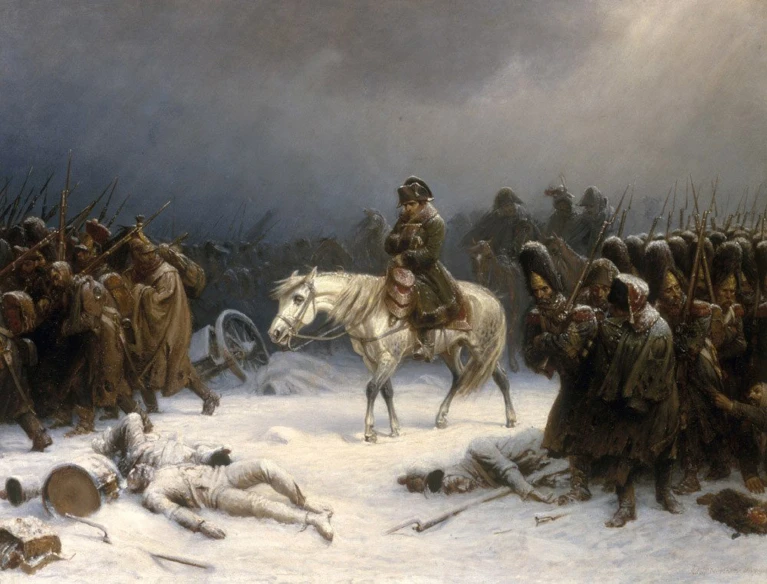
More than two hundred years after Napoleon Bonaparte’s fateful retreat from Moscow, modern science has finally given new life to one of history’s most tragic military mysteries. A group of French soldiers who perished during the disastrous 1812 campaign have now received a posthumous medical diagnosis — one that sheds light on the unseen biological enemies that struck them down long before gunfire or frostbite did.
While historians have long chronicled how Napoleon’s once-mighty army was ravaged by hunger, exhaustion, and the brutal Russian winter, recent DNA analysis has revealed two previously unknown infectious diseases that may have hastened the troops’ collapse. The discovery, published in Current Biology, challenges earlier explanations and paints a more intricate picture of the hardships faced by the soldiers during their desperate retreat.
Anne Stone, a genetic anthropologist at Arizona State University who was not involved in the study, praised the research for both its scientific precision and historical significance. “This paper will be fascinating to history enthusiasts,” she said. “It’s an example of how ancient DNA studies can bring the past vividly back to life.”
Revisiting a Historical Catastrophe
When Napoleon’s army of over 600,000 men marched into Russia in the summer of 1812, few could have imagined the devastation that awaited them. Only a fraction survived the retreat from Moscow, as starvation, hypothermia, and disease tore through the ranks. Historians and medical researchers have debated for generations which illnesses contributed to the catastrophe.
In 2006, scientists believed they had solved part of the puzzle. Through DNA analysis of soldiers’ remains found in Lithuania, they identified two major pathogens: Rickettsia prowazekii, the bacterium responsible for typhus, and Bartonella quintana, which causes trench fever. Both diseases are transmitted by body lice — a common scourge among troops living in unsanitary conditions. The discovery matched historical reports describing fever, rashes, and delirium among Napoleon’s soldiers, reinforcing the theory that lice-borne illnesses were key culprits behind the army’s downfall.
However, the 2006 study used polymerase chain reaction (PCR), a method that amplifies specific DNA sequences. While effective for detecting known pathogens, PCR is limited when it comes to identifying unknown or unexpected infectious agents. In other words, it confirms what researchers suspect but cannot easily reveal surprises.
A Fresh Look with New Tools
Nearly two decades later, Nicolás Rascovan, a paleogenomicist at the Pasteur Institute in Paris, decided it was time to revisit the mystery using far more advanced techniques. “After twenty years, we had the tools to ask deeper questions,” he explained. The new approach, known as shotgun metagenomic sequencing, allows scientists to analyze millions of DNA fragments simultaneously, scanning for genetic traces of any known pathogen — not just those already suspected.
Rascovan’s team examined the teeth of 13 soldiers whose remains were excavated in 2002 from a burial site near Vilnius, Lithuania, believed to contain victims of Napoleon’s retreat. Teeth are valuable for such studies because they often preserve blood-borne pathogens protected within the dental pulp. By sequencing the DNA contained in these samples, the researchers could identify genetic material belonging to bacteria that had infected the soldiers at the time of their deaths.
The results were startling. Four soldiers showed evidence of infection with Salmonella enterica, the bacterium responsible for paratyphoid fever — a disease that causes high fever, diarrhea, and distinctive rose-colored spots on the skin. Two others carried DNA from Borrelia recurrentis, a louse-borne pathogen that leads to relapsing fever, characterized by recurring cycles of fever, chills, and exhaustion.
These findings point to a broader range of diseases circulating among the French troops than previously believed. The soldiers were not merely battling typhus and trench fever but also multiple infectious agents attacking simultaneously, compounding the devastating effects of starvation, dehydration, and cold exposure.
The Invisible Killers Behind the Collapse
Rascovan and his colleagues found no DNA traces of Rickettsia or Bartonella in their samples, despite those pathogens being detected in earlier studies. There are several possible explanations. It may be that the 13 soldiers tested this time represented a small, localized group that did not carry those particular infections. Alternatively, the new sequencing method, while powerful in scope, may have lower sensitivity than PCR for certain pathogens present in extremely small amounts.
Regardless, the takeaway is clear: there was no single epidemic that destroyed Napoleon’s army. Rather, a combination of multiple infectious diseases — each spread by lice, contaminated food, or unsanitary living conditions — converged to create a lethal environment. “These people died of a multiplicity of factors,” Rascovan said. “Probably many more than the ones we’ve found so far.”
Beyond disease, the soldiers were exposed to extreme cold, malnutrition, and the psychological trauma of constant retreat. The infamous Russian winter, which plunged temperatures to below –30°C, froze men and horses alike. Combined with bacterial infections that weakened their immune systems, it’s no wonder that so few made it home.
Lessons from the Past and the Future of Paleogenomics
The study’s implications extend far beyond the Napoleonic Wars. It demonstrates how advances in paleogenomics — the study of ancient DNA — can help historians uncover the biological context of historical events. Diseases that once went undocumented in written records can now be identified centuries later through molecular evidence, reshaping how we understand human history.
For scientists like Rascovan, this is just the beginning. He notes that most of the dental samples from the Lithuanian excavation have already been analyzed, but he suggests waiting before testing the remaining ones. “Let’s hold off until we have even more powerful techniques,” he said. “Technology is evolving so quickly that in another decade, we may be able to detect things that are invisible to us today.”
This patient approach reflects a broader trend in archaeological science — preserving precious ancient samples for future generations of researchers equipped with even more sensitive tools. As DNA sequencing continues to improve, we may one day uncover the full microbial landscape that shaped some of history’s most decisive moments.
A Window Into Human Endurance
The new study also serves as a reminder of the fragile balance between human ambition and nature’s microscopic forces. Napoleon’s invasion of Russia was a campaign driven by strategic power and political vision, yet its undoing came largely from unseen pathogens. In an age before germ theory, the French soldiers could not have known that lice and bacteria — not just the enemy’s guns — were among their deadliest foes.
Two centuries later, the combination of history and modern genetics allows us to honor these soldiers not merely as casualties of war but as early victims of infectious diseases that humanity has battled for millennia. Their suffering, now illuminated by science, tells a story of endurance, tragedy, and the relentless march of discovery.
In bringing these long-lost soldiers back into focus, scientists have done more than just solve a historical puzzle. They have reminded us that even the grandest human ambitions can be undone by the smallest living things — and that every skeleton buried beneath the soil may still have a story left to tell.





Leave a Reply