
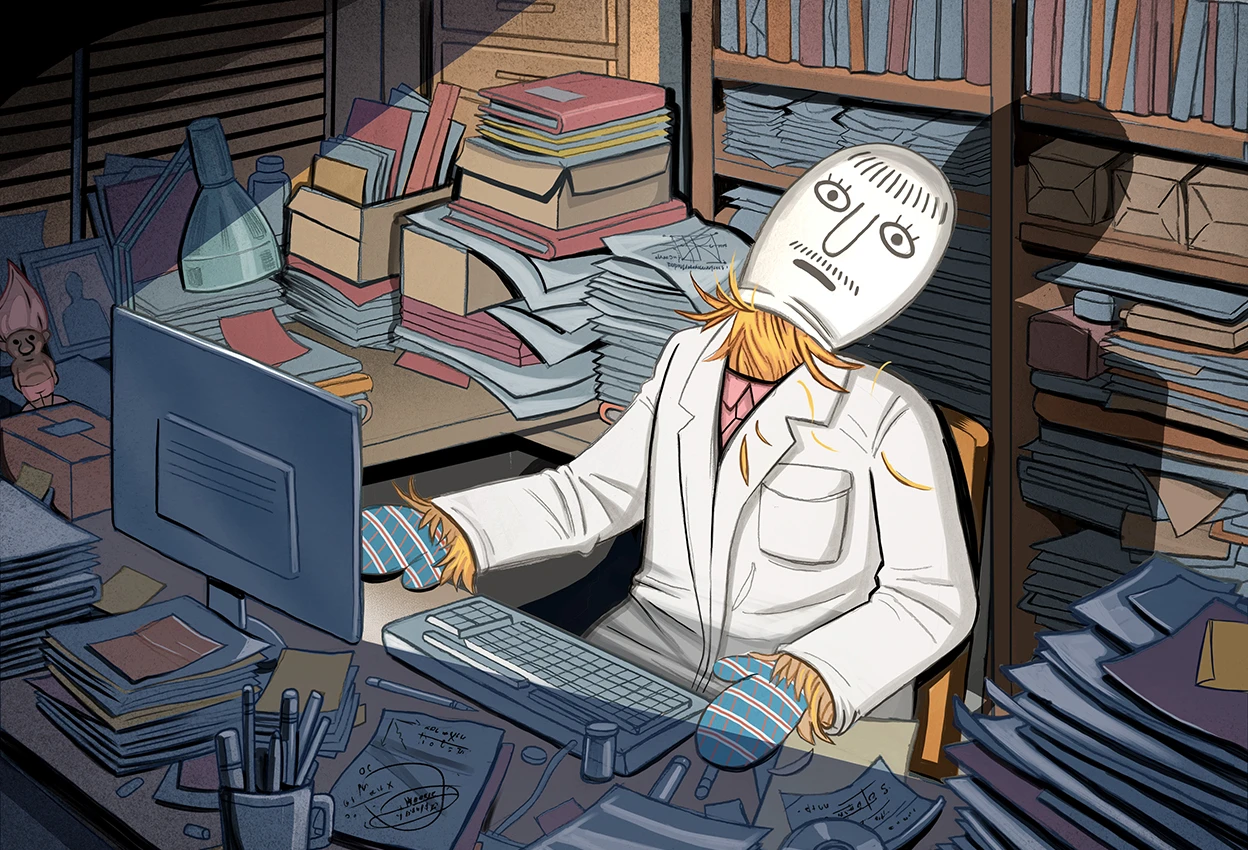
Beatriz Ychussie appeared to be on a fast track in the field of mathematics. During her tenure at Roskilde University in Denmark, she produced an impressive body of work. Between 2015 and 2016 alone, she published four papers covering topics ranging from quantum particle formulas to heat flow and geometric analysis. She also reviewed multiple submissions for respected academic journals, giving the impression of a rising star in her field.
However, this promising trajectory suddenly vanished. Investigations conducted by the publisher behind three of her articles revealed not just flaws in the research itself, but a startling truth: Ychussie did not exist.
Her name was part of a network of 26 fictitious academics, including both authors and reviewers, who had infiltrated four mathematics journals published by the London-based company Springer Nature. These invented scholars were products of what is known as a paper mill—a business that produces fraudulent research papers and manipulates the peer review process. By generating fake identities, paper mills can supply journals with a stream of publications and positive reviews, ensuring that the submissions they sell to paying clients appear legitimate and gain credibility.
In this particular case, the paper mill deployed two dozen fictitious personas, which led to the publication of 55 papers—a record among the known instances of such misconduct. After a thorough investigation, Springer Nature, which also publishes the journal Nature, retracted all three of Ychussie’s papers. While the journal’s editorial teams operate independently, the incident highlighted vulnerabilities in the scholarly publishing system.
Instances of fabricated reviewers are more frequent than fake authors, though both types of deception have been identified across the publishing landscape. Experts acknowledge that while these cases may not represent the majority of submissions, the true extent of the problem remains unknown. “We’re just flying completely blind here,” says Reese Richardson, a metascientist at Northwestern University in Illinois. Beyond creating entirely fictitious individuals, paper mills and unscrupulous researchers sometimes impersonate real academics, using their identities to lend credibility to fake or low-quality papers.
Most publishers already attempt to verify author identities before accepting manuscripts. Some perform basic checks, such as confirming that the submitting scientist uses an institutional email address. Others implement more comprehensive measures. Frontiers journals, for example, cross-check author records, previous publications, and request confirmation from co-authors about their contributions.
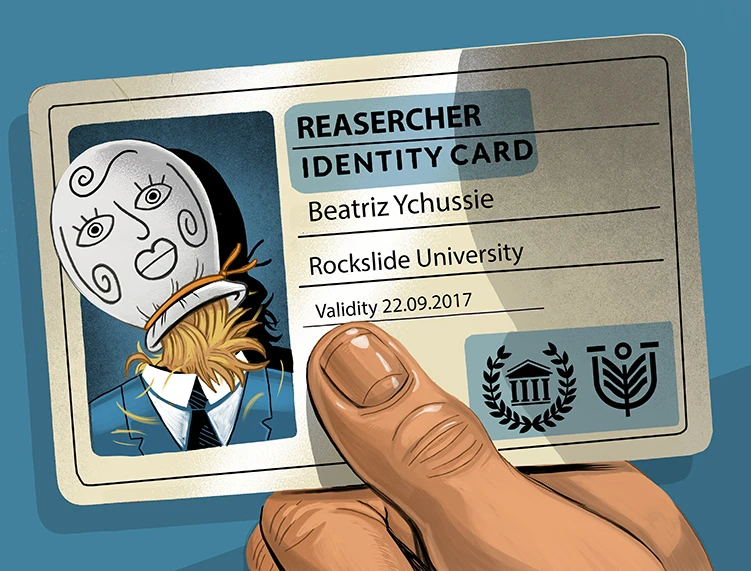
Still, identity verification remains challenging because communication between editors, reviewers, and authors is typically conducted remotely. Academic publishing relies heavily on trust. Discussions are ongoing about whether stricter identity verification measures should be adopted, such as requiring institutional email addresses, university login credentials, or even official documents like passports.
These measures, however, carry risks. Scholars who are independent, early in their careers, or based in countries with limited institutional resources may not have access to standard institutional emails. “Journal editors may not feel comfortable acting as ‘immigration officers,’ checking the identity of every contributor,” says Adya Misra, associate director of research integrity at Sage Publications in Liverpool. There is currently no standardized definition across the industry for what constitutes a verified researcher.
The saga of Ychussie began to unravel in 2018 when a reader noticed two flawed and nearly identical papers published the previous year and reported them to the journals. Springer Nature’s investigation revealed that both papers had used fictitious reviewers. This discovery uncovered a much larger problem. Some of the fake reviewers had already appeared as authors on earlier submissions, as certain journals allow authors to recommend reviewers. Once these fake names appeared in the author list, they were repeatedly suggested for review assignments.
Between 2013 and 2020, the paper mill orchestrated the publication of 55 papers using 13 fictitious reviewers and 13 fake authors, who were supposedly located around the globe. Most of the fake authors only appeared on a single paper but were recommended as reviewers 68 times, while the remaining fake personas, who had no prior publication history, were invited to review 25 times. When Springer Nature contacted the institutions that these individuals were purportedly affiliated with, the universities confirmed that none of them had ever been employed there.
Tim Kersjes, head of research integrity at Springer Nature, explains why paper mills invest effort in creating fake authors: those with prior publication history were more likely to be invited to review subsequent papers, helping the mill ensure its submissions were accepted. It took the publisher two years to complete its investigation into the ring of fictitious scientists, eventually concluding that the operation was likely based in China. By early 2021, all affected papers had been retracted.
“Science has always been based on trust, and awareness of identity fraud in peer review was limited at the time,” Kersjes says. “Such manipulation was rare, and editors were less alert to the risks. We now have stricter checks and better training for editors.” Kersjes presented the team’s findings at the 10th International Congress on Peer Review and Scientific Publication in Chicago.
Fictitious researchers are only one form of identity fraud. Paper mills and individuals may also impersonate real scientists to submit fabricated or substandard work. Earlier this year, Diomidis Spinellis, a software engineer at the Athens University of Economics and Business, found 48 articles in a single journal that he suspected were AI-generated. One paper even listed him as an author without his consent, while others included researchers from prestigious institutions but used incorrect or non-institutional email addresses. Some of the named co-authors had been deceased for years.
Even using an institutional email is not a guaranteed safeguard. A preprint released in August identified 94 fake profiles on OpenReview.net, a peer review platform, most of which had email addresses tied to legitimate universities. Some imposters had even created email aliases to redirect communications to accounts under their control.
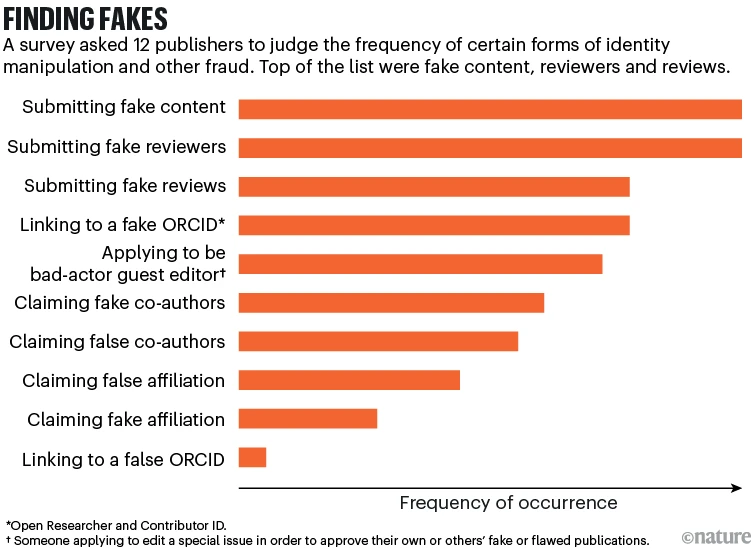
It remains unclear whether the frequency of identity fraud in academic publishing is increasing. Elena Vicario, head of research integrity at Frontiers in Switzerland, notes that such incidents are rare in her journals and usually involve impersonation of real researchers. Richardson argues that unethical conduct under one’s real name is a larger concern than identity theft, but the rise of AI may complicate the landscape further, prompting publishers to strengthen verification procedures.
One tool gaining traction is ORCID, launched in 2012, which provides researchers with a unique 16-digit identifier to track publications and academic contributions. Around 10 million researchers use ORCID annually, and many publishers now require submitting authors to provide their identifier. ORCID’s “trust markers”—verified entries confirming affiliations, publications, or reviews—are intended to help establish credibility. Still, the platform cannot fully guarantee identity, as anyone can register, and verification practices vary among publishers.
Recent efforts to strengthen verification include initiatives by the International Association of Scientific, Technical & Medical Publishers (STM), which released recommendations for combining multiple risk and trust indicators. Methods include checking institutional emails, confirming affiliations through university login systems, or using fallback measures such as video calls or identity documents. STM emphasizes flexibility to avoid unfairly excluding independent or early-career researchers.
Start-ups have also begun offering tools to assist with identity verification. VeriMe, developed by former ORCID executive Laurel Haak and her colleagues, combines multifactor authentication, institutional email checks, and optional passport validation to assess researcher credibility. Other automated systems analyze co-authorship networks to detect patterns suggesting paper mill activity, though costs and privacy concerns remain barriers for some publishers.
Experts caution that no verification system is perfect. Examining identification documents does not necessarily indicate whether a researcher is diligent or ethical. Richardson warns that over-reliance on trust markers could itself be exploited, creating new opportunities for fraud. He argues that the root issue lies in the incentives of academia, which prioritize quantity of publications over quality, allowing paper mills to thrive.
Ychussie’s final paper, published in 2016, was a flawed study on the mathematics of cone-shaped spaces. Retracted in 2020, it marked the end of her brief existence. While she never existed, the creators behind her and other fabricated academics are very real, and their work continues to challenge the integrity of scientific publishing.




Leave a Reply