
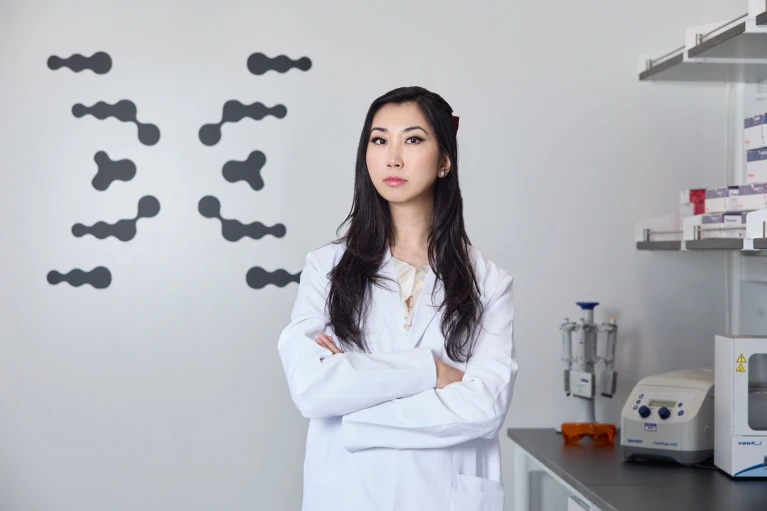
Cathy Tie’s path into biotechnology has never followed tradition. At just 18, she dropped out of university to launch her first life sciences startup, a daring move that set her apart in an industry dominated by advanced degrees and long research careers. In the decade since, she has founded multiple ventures: one helping genetic-testing companies interpret results, another building digital healthcare platforms. Now, she is turning her attention toward one of the most controversial frontiers in science: editing the genomes of human embryos.
Tie often refers to her latest company, Manhattan Genomics, as a modern-day Manhattan Project — invoking the historic U.S. government effort that created the atomic bomb. With that comparison, she signals the scale of ambition behind this mission: developing technology to modify embryos to prevent devastating genetic diseases before birth.
“We have a responsibility to patients suffering from severe, untreatable genetic disorders,” Tie says. “A majority of Americans support progress in this area.”
Her conviction is bold. And unsettling to some.
A new wave of embryo-editing startups
Manhattan Genomics, headquartered in New York City, quietly launched in mid-2024 and recently announced its first scientific and ethical advisers. Tie co-founded the company with Eriona Hysolli, formerly the head of biological sciences at Colossal Biosciences, a Dallas company known for pursuing species “de-extinction” projects. Meanwhile, another company called Preventive, based in South San Francisco, publicly revealed plans on the same day to explore similar embryo-editing strategies.
Both firms are backed by private investors. Neither has detailed which disorders they plan to target or which technologies they will rely on. Still, Manhattan Genomics has signaled that it intends to conduct rigorous research and safety testing before attempting any clinical use. Among its advisers are a bioethicist and two scientists who specialize in reproductive biology in primates — a necessary step for assessing safety before any human application.
Despite those preparations, many scientists and ethicists argue that the technology—and society—are not ready.
“It is far too early to commercialize heritable gene editing,” says Alexis Komor, a gene-editing researcher at the University of California San Diego. “The safety threshold must be extraordinarily high, and we simply are not there yet.”
Learning from past controversies
Human-embryo editing entered the global spotlight after Chinese biophysicist He Jiankui announced in 2018 that he had genetically modified embryos to resist HIV. Two gene-edited girls were born, sparking international condemnation and resulting in He’s imprisonment in China for illegal medical practices. That episode triggered global calls for a pause on heritable gene editing.
Although Tie briefly had contact with He earlier this year, she says that relationship has ended and that He has no involvement in Manhattan Genomics.
Meanwhile, advances in gene editing outside the embryo space have accelerated. In 2023, the first approved CRISPR-based gene therapy reached patients suffering from inherited blood diseases. Another milestone came this year, when a baby with a metabolic disorder received base-editing treatment in liver cells, demonstrating rapid progress in somatic (non-reproductive) genetic medicine.
Still, experts stress that what works in adult cells does not automatically translate to embryos. Editing heritable DNA means genetic alterations could affect every cell in a person’s body and pass to future generations. Off-target changes — errors introduced during editing — could have severe consequences.
“As powerful as these tools are, we must recognize the risks,” Komor says. “We are talking about altering all the cells in a developing human. That is very different from treating a single organ in an adult.”
Scientific gaps and ethical uncertainty
Tie and Hysolli argue that new technologies like base editing and prime editing have dramatically improved precision compared to traditional CRISPR-Cas9 methods. Importantly, these newer methods do not require breaking both strands of DNA, reducing the likelihood of dangerous chromosomal rearrangements.
However, researchers caution that even the most advanced techniques still carry unknowns.
Junjiu Huang, a pioneer in embryo gene-editing research at Sun Yat-sen University in Guangzhou, China, says his own studies show promise — but also limits. He was among the first scientists to edit human embryos in 2015, though those embryos were never implanted. According to Huang, base editing remains too immature for clinical use, and significant research must be done before commercialization.
Huang describes the timing of Manhattan Genomics’ launch as premature: “The science is not mature, and neither are the ethical frameworks, legal protections, or global consensus.”
Tie sees things differently. She argues that delaying research won’t resolve ethical questions — only responsible scientific progress can.
“If we retreat from innovation out of fear, we make no progress at all,” she says.
Private funding steps in
In the United States, government restrictions currently prevent federal funding from supporting embryo-editing research and prohibit regulatory approval for implanting genetically modified embryos. This gap opens the door for private industry to lead development — a reality that supporters say could accelerate innovation and detractors say could weaken oversight.
Preventive, led by scientist Lucas Harrington, has already raised nearly $30 million from private investors. Harrington previously co-founded a company with Nobel laureate Jennifer Doudna, one of the pioneers of CRISPR-Cas9. Doudna remains cautious about heritable gene editing but says she supports high scientific and ethical standards in this emerging field.
Shoukhrat Mitalipov, a renowned reproductive biologist at Oregon Health & Science University (OHSU), is consulting for Manhattan Genomics, signaling growing involvement from mainstream scientists.
More companies are likely to follow, says Paula Amato, an OHSU reproductive endocrinologist and Preventive adviser: “We are at the very beginning.”
Public opinion and the slippery slope debate
Polls show mixed public views. A Pew Research Center report found that most Americans support editing embryos to prevent serious genetic disease — but the majority oppose editing embryos when it comes to enhancement traits like intelligence or physical performance.
Kelly Ormond, a bioethicist at ETH Zurich, says public understanding remains limited, and support often shifts depending on how questions are framed.
Tie emphasizes that her company is not pursuing enhancements. Most scientists agree that meaningful genetic enhancement is currently far beyond reach. Complex traits like intelligence involve networks of genes that remain poorly understood.
“We’re not capable of large-scale trait engineering today,” Komor says. “But we should be prepared for the future, because knowledge will evolve.”
A new chapter in human genetics
Manhattan Genomics and Preventive are stepping into territory that bridges cutting-edge science, high-stakes ethics, and global public policy. Whether their work accelerates progress toward eliminating genetic disease — or reignites fears of designer babies — may depend not only on technological breakthroughs, but also on transparency, oversight, and societal values.
For Tie, the mission is personal and urgent. For many scientists, caution must come first.
The world will be watching as the next phase of genome editing unfolds — not only in laboratories, but in public debate, regulatory corridors, and ethical discussions that shape the future of medicine itself.





Leave a Reply