
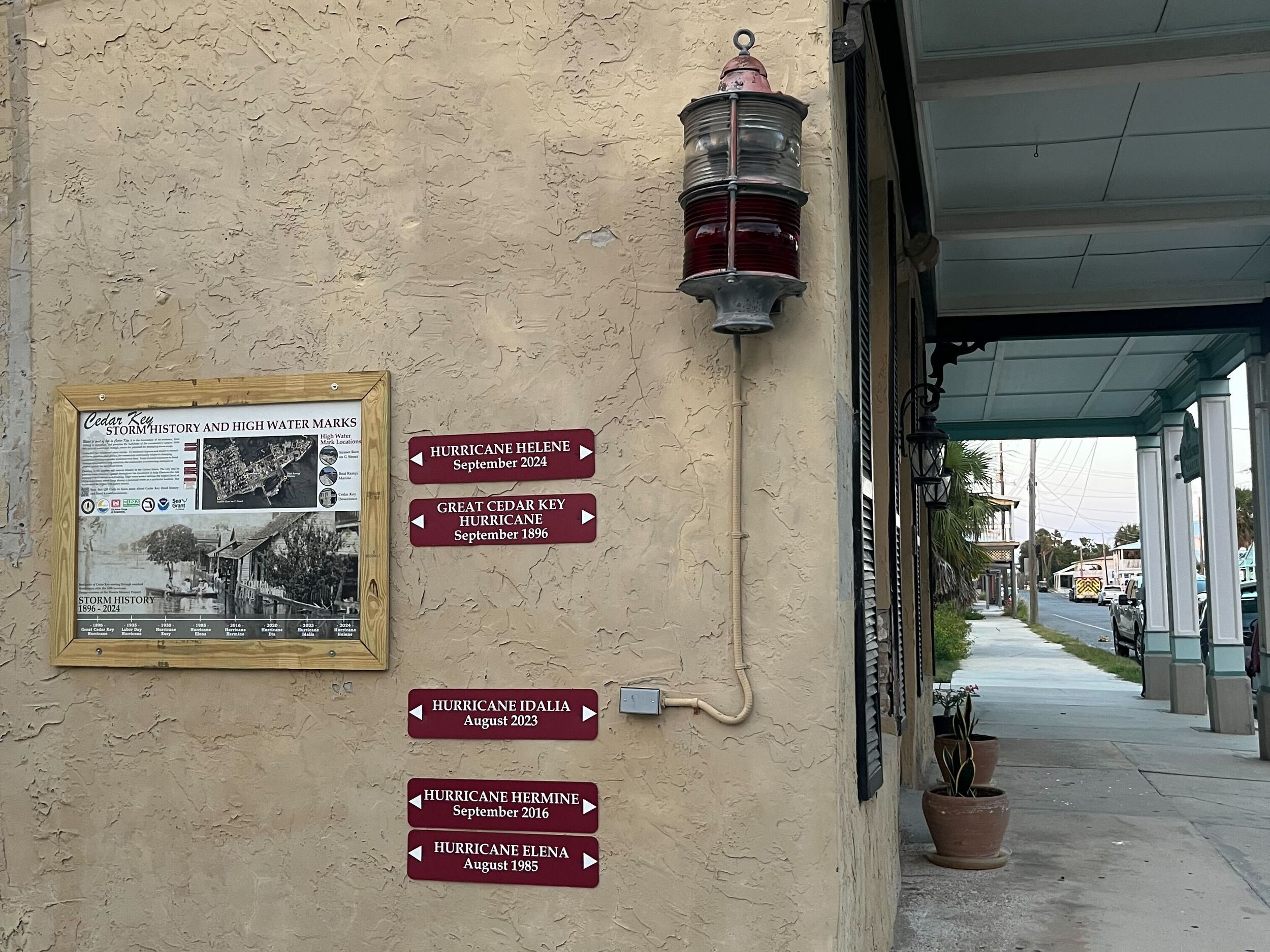
Situated along Florida’s Gulf Coast just south of the Panhandle, Cedar Key is a small, low-lying barrier island community that is home to roughly 800 year-round residents. Over time, that number has steadily declined as residents face mounting challenges from frequent flooding. Rising sea levels, intensified storm surges, and a series of powerful hurricanes have taken a heavy toll on the island’s shoreline and built environment, making daily life increasingly uncertain.
Evidence of repeated hurricanes is woven into the fabric of the town. Many storefronts are boarded up, spray-painted with the names of businesses that once operated there or directions to where they have relocated. Along the main road, markers indicate historic flood levels from past storms, serving as a visible reminder of how often the island has been inundated. The most severe of these events was Hurricane Helene in 2024, which brought an estimated storm surge of eight to twelve feet, enough to flood most of Cedar Key. According to media accounts, approximately one quarter of the island’s homes were destroyed during that storm, along with numerous local businesses. Although the damage from recent hurricanes is still evident, residents are determined to find ways to strengthen their community and adapt for the future.
Building Resilience Through Nature-Based Approaches
To address growing flood risks and other climate-related threats, Dr. Savanna Barry and her research team at the University of Florida have partnered with the Cedar Key community on a project supported by funding from the Gulf Research Program. The initiative focuses on developing nature-based solutions, which rely on restoring or enhancing natural and modified ecosystems to reduce hazards such as flooding while delivering environmental and social benefits.
In coastal settings, these strategies often take the form of living shorelines. Rather than relying on hard infrastructure like concrete seawalls, living shorelines use materials such as native vegetation, rocks, and oyster shells to stabilize coastlines. Beyond protecting against erosion, these features can improve water quality, create habitat for fish and wildlife, store carbon, and reduce the force of incoming waves.
Turning Collaboration Into Action
Cedar Key’s interest in nature-based solutions did not emerge overnight. Earlier collaborations between city leaders and University of Florida researchers explored living shoreline concepts, sparking broader conversations about how these approaches could be expanded to protect public infrastructure threatened by sea level rise, frequent storms, and ongoing erosion.
Dr. Barry’s current project centers on an area that includes critical emergency access routes, a popular shoreline fishing location, a public school, residential neighborhoods, small businesses, and aging stormwater systems. For former Cedar Key mayor Sue Colson, who stepped down from office in April 2025, the effort represents a practical pathway toward safeguarding the town. She noted that the project’s value was clear from the very first workshop, emphasizing that meaningful outcomes depend on turning plans into action.
From the outset, the research team committed to creating designs shaped by local knowledge and priorities. During the project’s initial phase, they organized stakeholder workshops and surveys, conducted site visits, and combined technical expertise with community preferences, infrastructure constraints, and equity considerations. This process ensured that proposed solutions reflected how residents actually live and interact with their waterfront.
After six months of refinement and community feedback, the planning phase produced conceptual designs for a hybrid living shoreline. These concepts blend natural elements, such as oyster reefs, with engineered features including rain gardens, sea groins, and permeable pavement. The result is a flexible approach that balances ecological function with practical needs.
Community input played a decisive role throughout the design process. Residents influenced decisions about where solutions would be placed, what types of features would be used, and how they would look. Feedback guided the selection of native plant species, led to the inclusion of recreational access along a sea groin with carefully planned pathways, and prompted the team to move away from an earlier design that relied on living breakwaters. Instead, the project shifted toward developing adaptable design templates that private property owners could use to manage flooding following Hurricanes Idalia and Helene.
Discussions with residents also highlighted practical challenges that must be addressed for long-term success, including parking availability, maintenance responsibilities, and overall costs. By addressing these concerns early, the designs better reflect how the waterfront is used and valued by the community.
Dr. Barry has emphasized that while community-driven design can be time-intensive, it almost always leads to stronger outcomes. Projects shaped collaboratively are more likely to be built, maintained, and supported by the people who depend on them.
Looking Ahead for Cedar Key
The benefits of this collaborative approach are already evident. Following conversations at the project’s first workshop, city staff explored the installation of check valves at the most vulnerable stormwater outfalls. These devices regulate water flow and help prevent backflow during high tides and heavy rainfall. When a major rain event occurred just a month later, causing flash flooding in parts of Cedar Key and nearby Levy County, the sites equipped with new valves successfully drained water away. Areas that previously flooded with saltwater during extreme tides have remained dry since the installations, even during subsequent high-tide events. For city officials, these early results demonstrated the value of implementing solutions grounded in scientific research and local input.
Despite these successes, the challenges facing Cedar Key remain significant. Nature-based solutions can reduce the impacts of flooding and storms, but rising seas and increasingly intense weather will continue to shape life on the island.
Dr. Barry has noted that Cedar Key, like many small coastal communities, must adapt in multiple ways to live with climate change. Alongside nature-based strategies, city leaders are pursuing broader efforts such as elevating homes and roads and relocating critical infrastructure to higher ground. While nature-based solutions alone cannot fully protect the island, they can help preserve cherished aspects of community life, including simple rituals like watching sunsets along G Street.
As Cedar Key moves toward implementation, the project team hopes their work can serve as a model for other communities seeking to co-design climate solutions with residents. Although the proposed designs have received strong local support, securing the funding needed to turn plans into reality remains a challenge. For Dr. Barry and community leaders alike, the next steps will determine whether this collaborative vision translates into lasting resilience.





Leave a Reply